
















Three economists share Nobel for explaining innovation-driven, sustained growth
text_fields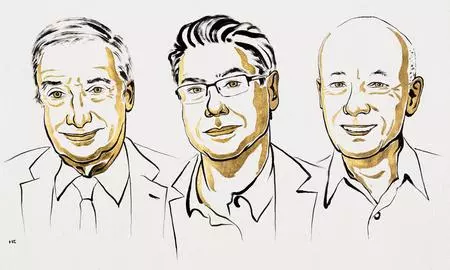

Stockholm: The 2025 Nobel Prize in Economic Sciences has been awarded to Joel Mokyr of Northwestern University (US), Philippe Aghion of the Collège de France and INSEAD (France), and Peter Howitt of Brown University (US) for their pioneering work explaining how innovation drives sustained economic growth.
Announcing the winners on Monday, the Royal Swedish Academy of Sciences said one half of the prize was awarded to Mokyr “for having identified the prerequisites for sustained growth through technological progress”, while the other half was shared by Aghion and Howitt “for the theory of sustained growth through creative destruction.”
“Over the last two centuries, for the first time in history, the world has seen sustained economic growth. This has lifted vast numbers of people out of poverty and laid the foundation of our prosperity. This year’s laureates in the Economic Sciences, Joel Mokyr, Philippe Aghion and Peter Howitt, explain how innovation provides the impetus for further progress,” the Academy said in a statement.
Mokyr, a historian of economic thought, used historical evidence to uncover why sustained growth became possible. His research showed that for innovation to continue in a self-sustaining cycle, it is not enough to know that something works, societies must also understand why it works. Before the Industrial Revolution, such scientific explanations were often lacking, preventing cumulative progress. Mokyr also highlighted the importance of openness to new ideas and societal acceptance of change.
Aghion and Howitt, meanwhile, developed a mathematical model in 1992 describing the process of “creative destruction”, where new technologies and products replace older ones, spurring innovation but also rendering established firms obsolete. Their model illustrated how progress, while creative, is also inherently disruptive.
The Academy said their combined work demonstrates that economic growth depends on managing the conflicts created by innovation. Otherwise, vested interests may block progress, it noted.
“The laureates’ work shows that economic growth cannot be taken for granted. We must uphold the mechanisms that underlie creative destruction, so that we do not fall back into stagnation,” said John Hassler, Chair of the Committee for the Prize in Economic Sciences.
Last year, the Nobel Prize in Economics went to US-based economists Daron Acemoglu and Simon Johnson of MIT, and James A. Robinson of the University of Chicago, for their research on how institutions shape national prosperity and explain why some countries are rich while others remain poor.