


















NASA’s ESCAPADE mission to probe space weather between Earth and Mars
text_fields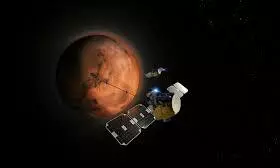

NASA’s ESCAPADE mission is set to launch twin satellites in 2025 to study space weather and its impact on Mars, aiming to better understand how the Red Planet lost its once-thick atmosphere.
The mission will observe how the Sun’s charged particles, known as the solar wind, interact with Mars’s magnetic field and atmosphere.
ESCAPADE will be the first mission to deploy two orbiters around Mars simultaneously. The identical spacecraft will initially travel in the same orbit before shifting into different paths, allowing scientists to measure solar wind conditions at one point and atmospheric response at another. This two-point sampling is expected to help establish cause and effect, offering insights into how solar wind drives atmospheric escape and long-term climate change on Mars.
The mission, led by the University of California, Berkeley, is scheduled to reach Mars in 2027.
Space weather refers to conditions caused by solar activity, such as flares, coronal mass ejections, and the solar wind.
On Earth, intense solar storms can disrupt communications, GPS systems, and power grids, and increase radiation exposure for astronauts.
Mars is more vulnerable because it lacks a strong global magnetic shield, leaving its atmosphere exposed to erosion by solar wind. Scientists believe this process played a key role in transforming Mars from a planet that may once have supported liquid water into the cold and arid world seen today.