


Huge sunspot complex raises risk of strong solar storms
text_fields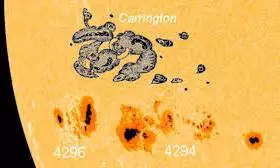

A massive sunspot complex has appeared on the Sun and is raising concerns about the potential for strong solar storms.
The cluster, identified as AR 4294 to 4296, is almost the size of the sunspot that triggered the 1859 Carrington Event.
Early December images show that the three linked active regions cover an area of about 180,000 kilometres. Astronomers say it is one of the largest sunspot groups seen in the past decade.
Spacecraft data indicate that the cluster spans about 90 percent of the area of the historic Carrington sunspot. The group has a complex magnetic field known as a beta gamma delta configuration. This type of field can store enough energy to release powerful X-class flares.
NASA’s Perseverance rover first detected the cluster from the Sun’s far side before it rotated into view.
Scientists say the sunspot complex has the potential to produce solar flares and coronal mass ejections. These eruptions can send charged particles toward Earth. Such events can disrupt satellites, radio signals, and power systems. They can also create widespread auroras. So far, no Earth-directed coronal mass ejection has been detected.
An X1.9 flare recorded on December 1 came from a different sunspot, AR 4295. Forecasters at NOAA expect more M-class flares and possibly stronger X flares from the active regions now facing Earth. They also caution that the situation remains stable at the moment. Experts say there is no sign of a storm on the scale of the Carrington Event.