

















Giant planets could form around supermassive black holes: scientists
text_fields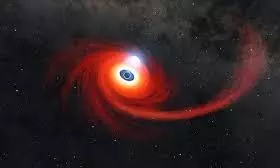

Scientists have proposed that active galactic nuclei (AGNs), the bright regions surrounding supermassive black holes at the centres of galaxies, could serve as birthplaces for giant planets despite their extreme and turbulent environments.
According to researchers, AGNs form when supermassive black holes are surrounded by vast amounts of gas and dust arranged in flattened disks. As material gradually spirals into the black hole, friction heats the surrounding matter, causing it to emit enormous amounts of light across the electromagnetic spectrum.
The idea challenges traditional assumptions about planet formation.
Scientists had long believed that the highly turbulent conditions within AGN disks would make it difficult for planets to develop. However, researchers suggest that the outer regions of these disks may have temperatures suitable for planet formation.
University of Colorado Boulder researcher Bhupendra Mishra said Jupiter-mass planets could potentially form within these environments. The proposed planets would be dust-rich giants with masses exceeding that of Jupiter and may resemble giant lava worlds.
Researchers believe that AGNs could potentially host large numbers of such planets due to the abundance of gas and dust available in their disks.
Detecting these worlds, however, remains a challenge.
Scientists suggest that gravitational lensing, a phenomenon in which gravity bends and magnifies light, could help identify clusters of planets forming in the outer regions of AGN disks.
Mishra said finding these planets would not be easy and would likely require favourable observational conditions. He added that further study of the model is needed, but expressed confidence that such planets could eventually be detected.
The findings suggest that planet formation may occur in environments previously considered too hostile, expanding scientists' understanding of where planets can emerge in the universe.