













2026 Nobel Prize in Medicine goes to trio for breakthrough in brain research
text_fields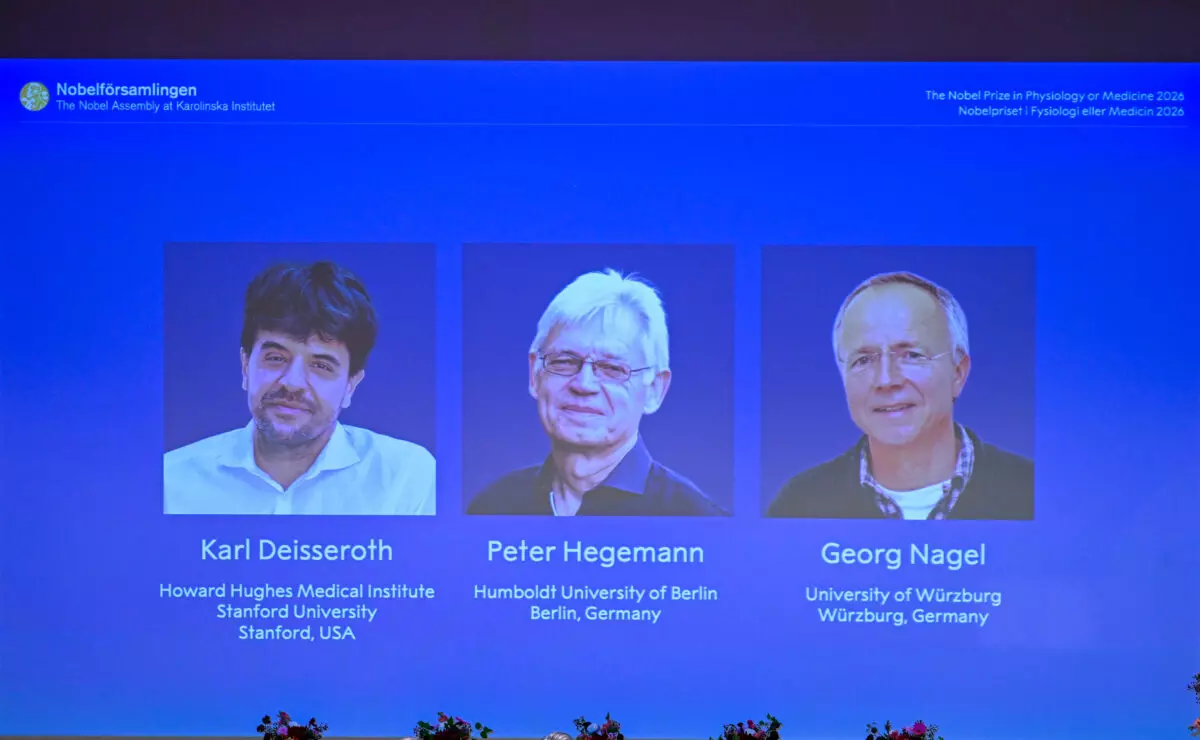

New Delhi: The 2026 Nobel Prize in Physiology or Medicine has been awarded jointly to Karl Deisseroth, Peter Hegemann and Georg Nagel for their discoveries involving light-gated ion channels and optogenetics, a technique that has transformed scientists’ ability to study the brain.
The Nobel Assembly at Karolinska Institutet announced the award in Stockholm on Monday, recognising work that has made it possible to precisely control the activity of individual nerve cells in living brains.
Optogenetics uses light-sensitive proteins to activate or inhibit selected neurons, allowing researchers to investigate how specific neural circuits influence memories, feelings and behaviour. “Optogenetics provides opportunities for mapping the brain in a way that we could once only dream of,” said Per Svenningsson, chair of the Nobel Committee for Physiology or Medicine.
Hegemann and Nagel played a key role in the discovery and characterisation of channelrhodopsins, light-sensitive proteins found in microorganisms. Their work showed that these proteins could function as light-controlled ion channels.
Deisseroth subsequently introduced the gene for channelrhodopsin into rat nerve cells and demonstrated that blue light could trigger nerve signals. He later applied the technique in the brains of living mice, establishing the foundation of what became known as optogenetics.
The technology has since become an important research tool worldwide. Scientists can use it to identify neural circuits involved in particular memories, emotions and behaviours, including those associated with neurological and psychiatric disorders.

The approach is also being explored for potential medical applications. Researchers are investigating its use in attempts to restore vision in people with severe visual impairment, among other possible therapeutic applications.
Deisseroth is a professor of bioengineering, psychiatry and behavioural sciences at Stanford University in the US. Hegemann is a German biophysicist who studied light-sensitive proteins in microorganisms, while Nagel, a German neuroscientist, contributed to the discovery and characterisation of microbial opsins and their function as light-controlled ion channels.
With IANS inputs