













The many meanings of Bihar's regime continuity
text_fields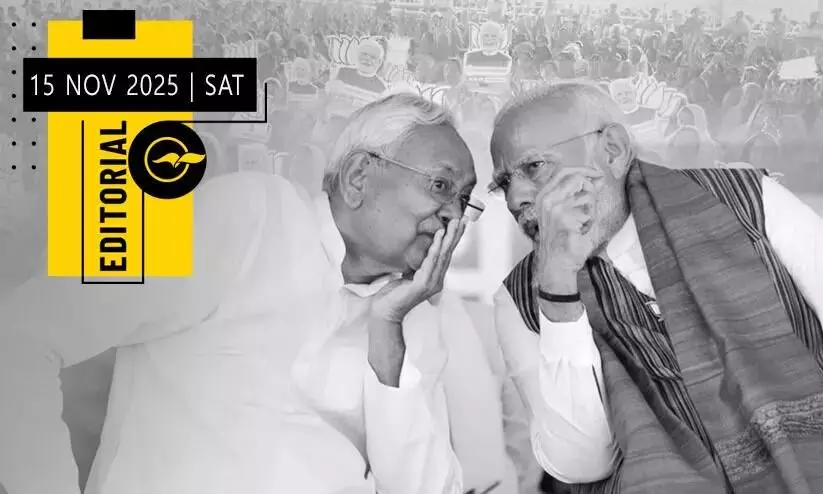

The NDA's victory in Bihar is one that surpasses the exit poll predictions; if and when Nitish Kumar returns to the post of chief minister with a higher majority, it will be the dawn of a new history in every sense. In all the post-election surveys conducted by more than a dozen agencies, the NDA had been predicted to return to power. However, the front was expected to win only 165 seats at most. It was also observed that the BJP would establish invincibility in the front and the assembly by keeping Nitish's JD(U) at its side. Nitish's performance during the election campaign also led to such an assessment. In other words, the exit polls reflected the victory of the BJP, which had prepared a strategy to make Nitish irrelevant in Bihar politics even while the NDA remained in power. Along with this, the survey results also indicated the possibility of the RJD, the main party in the INDIA Front, becoming the second largest single party in the assembly under the leadership of Tejashwi Yadav. But neither of these happened. While the NDA won more than 80 seats than in the previous elections, the JD(U) remains a crucial force; and the JD(U) is second only to the BJP in terms of party strength, winning more than double its seats won in 2020, Nitish is not becoming irrelevant as election experts predicted; he is also becoming a strong presence in national politics beyond Bihar. On the other hand, the INDIA alliance, which includes the RJD and the Congress, has suffered a major defeat despite organising a fairly good campaign.
The assessment of the Bihar election results would become more honest than what emerges from the ballot figures only when it is said that the country's first laboratory of the Special Intensive Revision of electoral rolls (SIR) is being conducted in the state, where the ruling party is seeking a two-thirds majority. The opposition and the country's civil society have expressed concerns from the beginning that the SIR is a process paving the way for the ruling class to continue in power; when the first draft of the voter list after the SIR came out in Bihar, this was found to be correct; later, even when the list was revised as a result of the intervention of the judiciary, more than half a crore voters were denied the right to vote. Bihar witnessed an election based on a voter list that excluded a large section of citizens by labelling them as ‘infiltrators’ and ‘immigrants’. It should also be noted that most of this exclusion took place in areas where the opposition front had potential. Apart from the SIR, it can be said that this is an election that was also affected by vote chori. The press conference held by opposition leader Rahul Gandhi at the party headquarters in Delhi on November 5, the day before the first phase of polling, can be read along with this. He presented evidence of how 25 lakh fake votes were created in the 2024 Haryana assembly elections. He had said that this vote chori, which is being carried out with the connivance of the Election Commission, would be repeated in Bihar too. This statement was made while presenting a few people who were removed from the voter list in Bihar without any particular reason. This was proven true in both the phases of the elections: many media outlets released footage of people who had exercised their right to vote in previous elections returning from the polling booths unable to vote.
Keeping all these in backgrounds, the election results in Bihar cannot be seen as a mere ‘people’s vote’. The statements made by opposition leaders including Akhilesh Yadav that a grand conspiracy has taken place should be taken seriously in the context of the SIR and vote chori. The allegation that the Election Commission, a constitutional institution, is working according to the whims of the ruling party is a long-standing one. However, for the last 10 years, the Commission's interventions have led to situations where anyone can doubt whether this institution has been crossing all boundaries and behaving as an ally of the ruling dispensaton. The SIR is just the latest example of this. When the SIR took steps to link the voter list with citizenship, what the Commission did was subvert the Representation of the People Act itself.
It is true that the opposition front has campaigned strongly in Bihar despite the obstacles created by the Election Commission and the central government. The team led by Tejashwi and Rahul Gandhi has also been able to expose the 10-year Nitish Kumar regime. It is also a fact that the SIR and vote chori issues have been brought to national attention through the campaigns in Bihar. The INDIA alliance, which resolved the obstacles that existed at the beginning of the campaign by announcing Tejashwi as the chief ministerial candidate, gave hope for a while. On the other hand, the poll arena also witnessed the Nitish camp in the NDA often choosing to remain silent. Many inherent weaknesses have gripped the opposition front. One such example is the fact that in Bihar politics, where caste equations are extremely decisive, the minorities have been kept away from the alliance. The fear that if Muslim minority political movements become part of the alliance, their secular image will be tarnished has always been a major weakness of our secular alliance. It happened here too. In fact, keeping Asaduddin Owaisi's Majlis-e-Ittehadul Muslimeen at bay was a setback for the INDIA alliance. The Majlis, on the other hand, contested alone and performed well. If they had come together, the front would have won at least four more seats in the Seemanchal region. It must be said that the opposition alliance failed in vote management as in Haryana. According to preliminary estimates, the INDIA alliance has received about five per cent fewer votes this time compared to 2020; the NDA has received about nine per cent more votes. This is including the five per cent votes received by the Lok Janshakti Party, which contested alone last time and is now part of the NDA. In other words, the total vote difference is less than five per cent. But the huge gap in the seat share is also due to the failure of vote management. Along with intensifying the fight against vote chori and the SIR, the INDIA alliance needs to urgently resolve this. Otherwise, the same fate as Bihar's will befall Assam, where the next elections are coming up.