














Kerala's Priyadarshini service and private buses
text_fields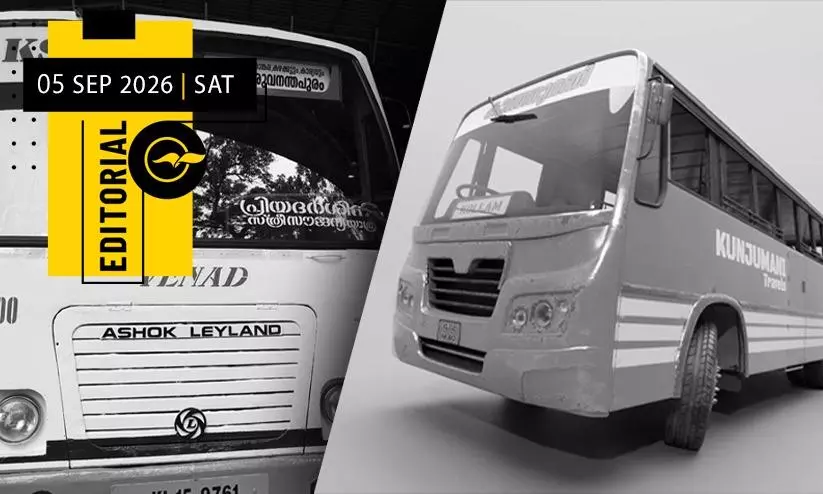

One of the major popular promises in the UDF (United Democratic Front) manifesto for the recent Kerala Assembly elections was free travel for women on KSRTC buses. The VD Satheesan government, which came to power with a landslide victory of more than 100 seats out of 140, adopted it in principle at its very first Cabinet meeting and announced that women and transgender persons would be allowed to travel free of charge on ordinary KSRTC buses under the ‘Priyadarshini’ scheme from June 15, 2026. Although the scheme became popular, three complaints were broadly raised regarding it. One, while the manifesto promised free travel for women on all KSRTC buses, the decision was limited to ordinary buses. Two, KSRTC’s ordinary services are limited in the Malabar region and, therefore, North Keralam would not benefit from ‘Priyadarshini’ to the required extent. And three, with the introduction of ‘Priyadarshini’, the private bus service sector would weaken further and more than half a million workers would be left in distress. The government proposed a phased solution to the first two criticisms. Initially, the government said that it would introduce free travel on ordinary services, assess the situation and then expand it to other services. In districts such as Malappuram, where ordinary services are lacking, the number of ‘Priyadarshini’ buses would be increased by including town-to-town services. The government also appointed a study committee to assess how ‘Priyadarshini’ would affect private bus services.
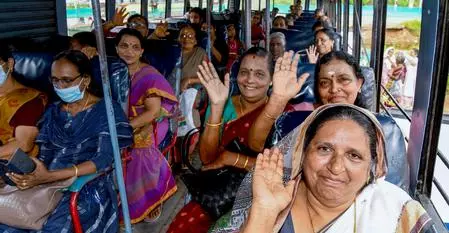
The report submitted on Wednesday by the expert study committee headed by retired IPS officer, former DGP and Transport Commissioner K. Padmakumar simultaneously highlights the potential of ‘Priyadarshini’ and the concerns raised by the private bus service sector. The committee also puts forward some suggestions that seek to address both. First, the report, supported by figures, shows that ‘Priyadarshini’ has opened up great possibilities for women in Keralam. During the month from June 16 to July 16, the first month of the scheme's roll-out, 50 per cent ‘extra travel’ was recorded on KSRTC’s ordinary services. In other words, KSRTC generated ticket revenue of about Rs 80 crore, the amount that would be paid by the state government to the transport department. For this, Rs 600 crore has been allocated in the Budget. This additional allocation is not actually a loss. For it is ordinary women workers and homemakers who rely heavily on ‘Priyadarshini’, and therefore this amount will be saved from their family budgets. This will also reach the open market. In that sense, ‘Priyadarshini’ is also a scheme that makes our circular economy more dynamic. However, since the distribution of ordinary services is not proportional to the population, it is not as effective in Malabar districts, including Malappuram as in the southern districts. There are a total of 3,125 Priyadarshini buses in the state; only a third of these operate in Malabar. While 687 buses operate in Thiruvananthapuram, there are only 98 Priyadarshini services in the most populous district of Malappuram. This gap in service distribution is specifically mentioned in the study report. It also provides a precise indication of what the next phase of the Priyadarshini project should look like.
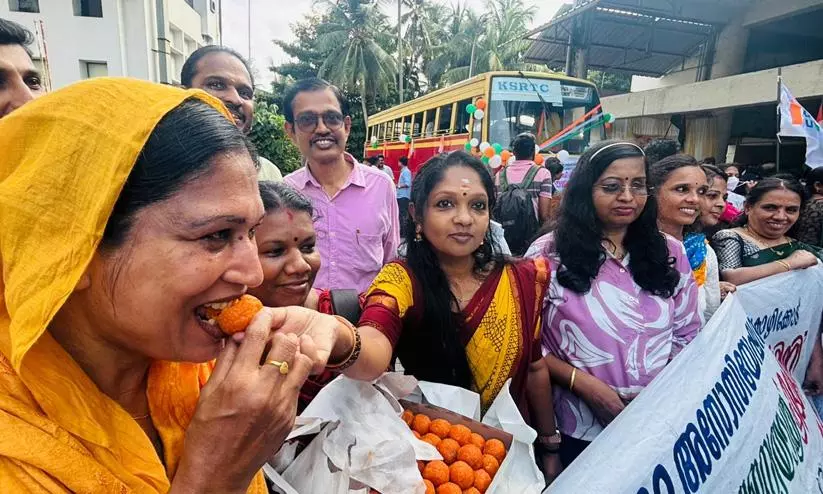
The study also highlights the current sorry state of the private bus service sector. Over the past quarter of a century, 5,336 private buses have disappeared from public roads in the state. In 2001, there were 19,018 buses, but now there are only 13,882. This did not happen with the arrival of Priyadarshini; the figures show that private buses have been gradually stopping their services, and this trend intensified during the Covid period. The constant rise in the prices of diesel and lubricants, the high cost of tyres and spare parts, high motor vehicle tax, insurance premiums that increase every year, the Motor Workers' Compensation Fund, permit renewal and fitness certificate fees are all factors that have exacerbated the crisis. Since employees’ wages are determined in proportion to ticket revenue, that also faced a crisis as revenue declined significantly. It was under these circumstances that bus owners were forced to reduce the number of employees per bus from three to two. It is a fact that the introduction of Priyadarshini services has further aggravated this crisis. While 3.8 crore journeys were made on KSRTC in June-July 2025, this increased to 5.75 crore in the first month of Priyadarshini. Of this, 3.81 crore journeys were made through the Priyadarshini service alone. A significant share of these were journeys that should have generated income for private buses. Private bus owners and workers have suffered such a loss of income. Taking this reality into account, the study committee has put forward a few suggestions. One of them is to lease private buses to KSRTC for the Priyadarshini service. Although this proposal could go some way towards addressing the loss of business for private bus owners and the shortage of Priyadarshini buses, it also has some complications. If this becomes a reality, these private buses will be operated by KSRTC employees. Naturally, this will result in job losses for private bus workers. In other words, the loss suffered by the bus owner will be compensated here, while the worker will continue to be left by the wayside. Therefore, some amendments are needed in this proposal. At the same time, proposals such as recognising the private bus service sector as an industry, increasing the service life of buses from 22 years to 25 years, and allowing private buses to refuel at KSRTC pumps are practical and will be beneficial for the private bus service sector.