
















Institutionalised corruption continues unabated
text_fields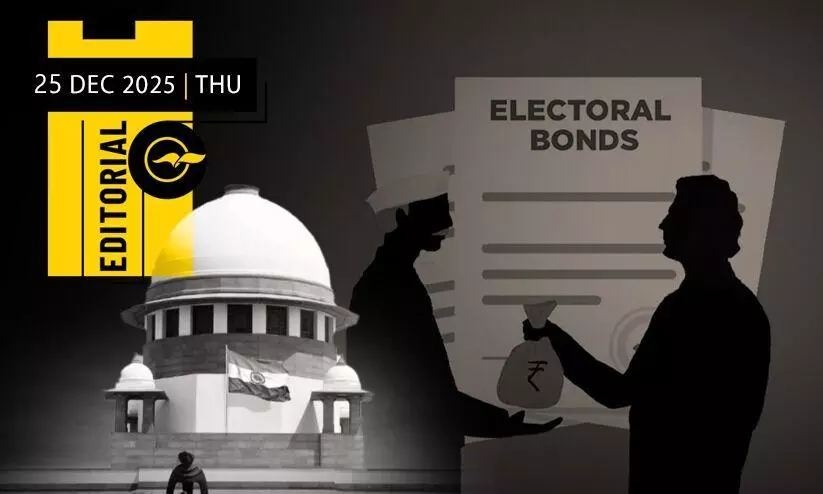

On February 15, 2024, the Supreme Court struck down the electoral bond system, stating that it was unconstitutional. The electoral bond, introduced by the Modi government under the pretext of curbing black money laundering by political parties, was viewed with suspicion by the public from the very beginning. Chief Justice D.Y. Chandrachud’s verdict underlined this concern. The court observed that the scheme lacked transparency and that the system undermined a citizen’s right to know who was contributing to which political parties, thereby dealing a major blow to the Modi government as the Lok Sabha elections drew near. The scheme was immediately criticised as a massive fund-raising mechanism for the BJP. The BJP received Rs 6,000 crore through electoral bonds in just five years. It is only when we realise that all political parties combined received merely around Rs 9,000 crore during this period that the extent of the Modi government's institutionalised corruption, orchestrated to line its own party's pockets, becomes clear. Now new figures show that even in the absence of electoral bonds, there is still no shortage of funds flowing to ruling parties. Election Commission reports bear testimony to the fact that corporates are pouring funds into political parties, including the BJP, through electoral trusts as a substitute for electoral bonds.
The Election Commission had earlier announced that individuals and corporates donated Rs 6,088 crore to the BJP in the financial year 2024–25. In the previous financial year, when electoral bonds were in place, the figure was Rs 3,965 crore. In other words, despite the Supreme Court intervening and cancelling electoral bonds, an additional income of 53 per cent has been recorded in the party fund. It should be added that the 12 opposition parties, including the Congress, received only Rs 1,343 crore during the same period. Corporate interference in Indian politics is a matter of common knowledge. Their influence and power in elections and governance have, on several occasions, been the subject of controversy. The Modi government sought to institutionalise these corporate interventions by inventing the electoral bond system. The system made it impossible for citizens to know who gave money to whom and how much, thereby keeping anonymous the real powers behind governance. Even in its absence, the extent of corporate subservience towards the ruling fascist party is truly shocking. The figures cited above also reveal how the BJP circumvented the electoral bond system. It can be seen that out of the total Rs 6,088 crore received, about 60 per cent, or Rs 3,744 crore, came through electoral trusts. When we understand what electoral trusts are, the depth of the corporate–BJP nexus becomes clear.
Electoral bonds were simple in principle. Bonds issued by the State Bank of India could be purchased by individuals and institutions and given to any political party, which could then encash them. The amount collected in this way had to be declared annually to the Election Commission. Although this appeared transparent, there were huge loopholes enabling institutionalised corruption. It enabled the real powers operating behind the scenes to remain anonymous by ensuring that citizens could not know who donated to whom or how much. That is why the Modi government brought in amendments through the Finance Act. This is the scam that the Supreme Court exposed. Electoral trusts, however, are different. These so-called trusts are special organisations that collect party funds from various sources. They are only required to submit details of the funds they receive to the Commission. In the last financial year, Rs 3,811 crore reached political parties through electoral trusts. Of this, Rs 3,744 crore went to the BJP. Among them, Prudent Electoral Trust, an organisation that has been funding the BJP for the past 11 years, made the largest contribution. As for those funding them, it is the big companies like Bharti Airtel, Megha Engineering, and DLF who previously helped BJP generously through electoral bonds. The picture, then, is clear: all the money that once flowed through electoral bonds is now reaching the same beneficiaries through electoral trusts. It has been years since corporate entities began determining the nation's policies. The electoral trust system, too, is effectively institutionalising the unholy nexus between the government and the corporate sector.