








Don’t yield to Hindutva for mere funds
text_fields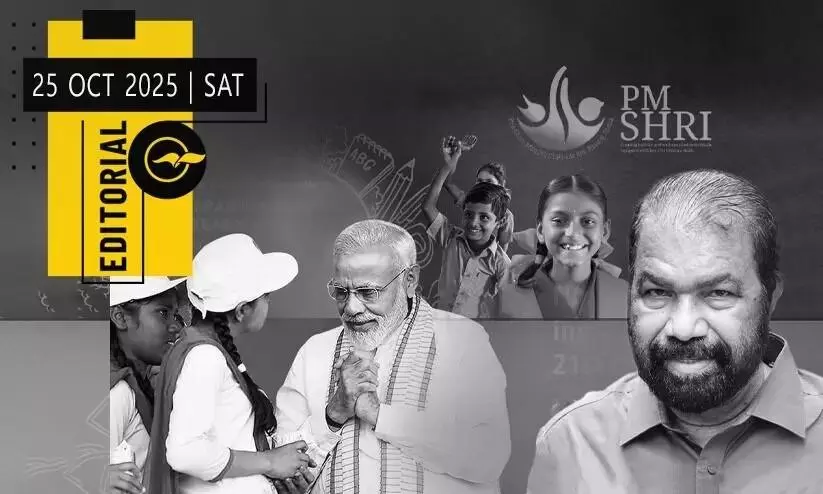

One of the fundamental factors that accelerated the momentum of the renaissance of Kerala was the struggles waged by various social sectors in the field of education. Kerala has a rich history of educational campaigns that made the fight against social and gender discrimination possible; it developed into a struggle against superstitions and outdated customs. Keralites take pride in the fact that modern Kerala was made possible only through the continuation of those struggles. After the formation of a united Kerala, the state was able to create distinctive models in the field of education, just as it did in the health sector. Seven decades into its existence, the state has witnessed a series of dynamic experiments throughout its history aimed at elevating the existing education model to new heights. Although such experiments have sometimes been subject to criticism, they have ultimately taken the state forward. While it can be said that all ministers of education from Joseph Mundassery to V. Sivankutty have played their part in those missions, the intervention of the Left in this process deserves particular mention. Kerala is currently ruled by a Left government that has introduced special schemes to protect public education. When the central government extended its overreach into the realm of education in a way that undermined the federal structure of the country and its secular values, it was the Left that led protests in the country, viewing it as a constitutional issue. Kerala, currently the only state ruled by the Left, adopted the strongest position against the Modi government’s National Education Policy (NEP), which aims to completely saffronise the education sector. While 95 per cent of the states in the country implemented the NEP, Kerala stood apart and came up with an alternative to the Centre’s regressive education policies. However, it must be said that those political positions now are a thing of the past. Kerala is now ready to collaborate with the Centre in the PM SHRI (Prime Minister’s Schools for Rising India) scheme, which is tied to the NEP. The signing of the memorandum by Public Education Secretary on PM SHRI the other day, ignoring the objections of allied parties including the CPI, is a clear indication of the political direction of the CPM itself.
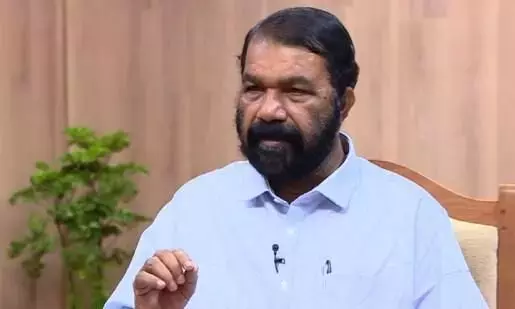
The CPM does regard the National Education Policy 2020 as an RSS-driven programme. The party has even moved a political resolution on this matter at its recent Madurai Party Congress. In Kerala, where the Left is in power, a committee headed by Prof. Prabhat Patnaik was formed to frame a special policy to resist the NEP. They projected Kerala’s education model as a brilliant political statement that does not compromise with the genocidal ideology of the RSS. Not only that, the CPM and the Left have developed this opposition politics to a certain extent at the national level. The CPM has now abandoned those political positions for ‘a few pieces of silver’. While signing of the PM SHRI agreement, the government has said that various education grants previously withheld by the Centre will be reinstated, and that additional revenue will be generated through the scheme. When the facts of this are examined, there is some truth to this: since 2022, no central allocation has been made for schemes including Samagra Shiksha Kerala (SSK), and last year the allocation was ‘zero’. Rs 1,200 crore is the approximate amount due under this head. Kerala could receive up to Rs 300 crore a year through PM SHRI. As the scheme is set to end in 2027, the maximum amount Kerala could get is under Rs 5,000 crore. The government and CPM leaders are asking whether the state can afford to forego such funds. They are also mentioning the central funds received through similar policies in the health and agricultural sectors. Which is true and right at first glance. However, it must be remembered that, for an amount receipt of which is only a possibility, the state is essentially yielding to the ideology of Hindutva.
With the implementation of the PM SHRI scheme, more than 300 public schools in Kerala will come under the Centre’s control. Many of them will be upgraded as model centres under the Public Education Mission. The names of these schools will have to be prefixed with ‘P.M. SHRI’, and the Prime Minister’s photograph will have to be displayed. Despite all this, what justification does the government have for NEP encroaching the curriculum? The CPM and the Left government have no dispute that the NEP curriculum and its teaching methods have already been fully saffronised. If the state makes a compromise with such an education scheme merely for the sake of funds, it will seriously undermine Kerala’s education model. There is also the risk that the government will be compelled to implement the NEP overall through the PM SHRI scheme. Another unfortunate reality is that this ‘deal’ allows Hindutva forces--which have so far failed to gain a meaningful foothold in Kerala’s parliamentary politics--to advance their agenda under the cover of the state’s largest political party. For this reason, the political criticism that this move cannot be considered innocuous must be taken into consideration. There is no doubt that through PM SHRI, the Left government has entered into a pact with Hindutva. Time alone will tell whether it was to ensure political survival or governance.