



















When Banyan, Mahua, and Peepal fade: A saga of vanishing ecology
text_fields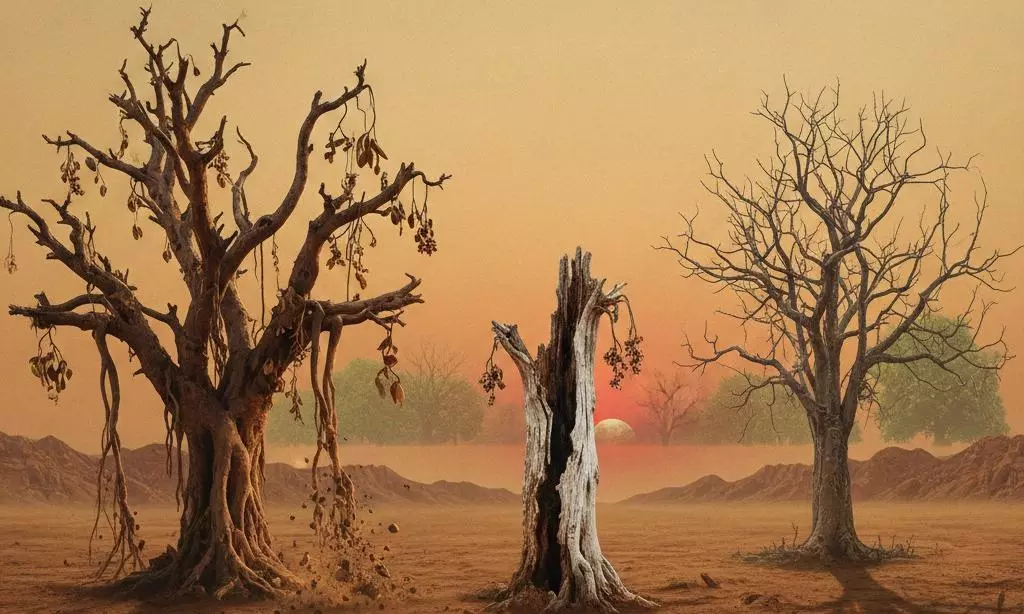

A stork left her home in a fit of anger and was fleeing when she came upon a large banyan tree, its branches lush and green. The tree noticed the bird hurrying past, dejected, and asked, “Why do you look so upset? Where are you going?”
The stork replied, “I am deeply hurt. My mother-in-law scolded and abused me for no genuine reason. I am on my way to my parents’ home.” The tree asked kindly, “Why did your mother-in-law scold you? You are so comely and adorable.”
The stork said, “While sifting rice grains from the husk, I ate a small morsel. That infuriated her. We got entangled in a vicious quarrel, which finally drove me to leave in a huff and head for my parents’ home.”
This is the opening of a famous folktale that personifies a small bird and a tree known for its hugeness yet selfless nature—offering relief, shelter, and tranquillity to a passerby troubled by heat and harsh weather.
It is difficult to ascertain the age of this folktale. But the village landscapes of Purvanchal—the western part of Bihar and eastern Uttar Pradesh in the Gangetic belt, where this writer was born and brought up—were dotted with banyan, mahua, peepal, neem, babul, and other traditional trees until the 1980s.
Yours truly remembers an elderly villager narrating this tale under a sprawling banyan tree outside his home on a hot summer afternoon in the 1970s. That memory later found a place in his first book of folktales, The Greatest Folk Tales of Bihar.
The point is this: the mahua, peepal, neem, babul, and banyan trees that once sustained rich biodiversity and ecological balance have died—largely unnoticed—over the last four decades.
Mahatma Gandhi described the 1934 Bihar earthquake as a “divine chastisement for the great sin,” while the great rationalist philosopher and humanist poet Rabindranath Tagore criticised Gandhi for his “unscientific views that strengthened elements of unreason.”
Yet, for people with lived experience, Gandhi’s observation—when viewed in the context of nature’s retaliation—may sound more plausible than Tagore’s critique framed through strict rationalism and scientific temper. For those born, raised, and growing old in Purvanchal, it is inexplicably painful to witness the disappearance of traditional trees that nurtured ecology and biodiversity for centuries.
Of Agriculture, Millets, and the India–US Trade Deal:
With the interim India–US trade deal threatening the survival of the country’s agriculture sector, the Narendra Modi–led dispensation has begun speaking more loudly about its efforts to save and popularise millets such as jowar, bajra, ragi, madua, kodo, tangun, and saayin through its “Shri Anna” scheme.
These millets have systematically vanished from north Indian agricultural tracts over the last four decades. Government policies—and their executors—remained largely blind to this extinction, even though these crops sustained and nourished the peasantry for centuries. Suddenly, the same mandarins now extol their nutritional and health benefits.
This amounts to little more than bluffing the people—nothing else.
The very factors that led to the extinction of millets also caused the disappearance of traditional trees.
The Bharatiya Janata Party government, fed on the contrite, convoluted, and shallow ideology of the Rashtriya Swayamsevak Sangh, thrives more on carefully curated “narratives” propagated by its IT cells and social media operators than on grounded policy rooted in lived realities.
The same machinery may soon be deployed when the megalomaniac President of the United States, Donald Trump—safeguarding the interests of capitalist corporations—tightens his noose around Modi, or a Modi-like dispensation. Backed by clever yet intellectually dishonest RSS functionaries and policymakers with scant understanding of grassroots India, such a regime may well promote genetically engineered trees on the graves of peepal, banyan, mahua, neem, and babul across the Gangetic belt.
A May 2024 study published in Nature Sustainability—a peer-reviewed journal of high credibility—reveals that approximately 5.33 million traditional trees vanished from India’s farmlands between 2018 and 2022. Among the species disappearing are neem, babul, mahua, peepal, and banyan.
Scant Respect for Federalism and an ‘Insensitive’ Ecological Policy:
The Nature Sustainability study titled “Severe decline in large farmland trees in India over the past decade” rightly observes that imported commercial species such as eucalyptus—known to lower groundwater levels—have steadily replaced traditional trees like peepal, mahua, banyan, neem, and babul. This replacement has played havoc with ecology, biodiversity, and the overall environment at the grassroots level in Bihar and Uttar Pradesh.
Yet, however scientific, methodical, and empirical these studies may be, they suffer from inherent limitations. There is no denying that they deploy scientifically approved tools to generate crucial data—data that is cardinal to policymaking. Still, they convey only a half-truth.
These studies may be largely accurate on scientific scales and empirical parameters, but they fail to tell us—holistically—how these traditional trees lovingly sheltered peasants and passersby, scorched by the harsh sun and exhausted by labour, as well as countless birds, reptiles, and insects.
They do not carry the melody of the ragas, the lyrics, and the ballads that sustained these trees and celebrated their quintessential selflessness, compassion, large-heartedness, and empathy. The souls of mahua, peepal, banyan, babul, and neem lived more vividly in the songs of folklorists, bards, and balladeers than in the laboratories of technocratic studies and research institutions promoted by profiteers and uncouth capitalists.
Policies and Folklore:
Hello, Commerce Minister Piyush Goyal:
You have drawn upon your education in management studies at Harvard Business School and training in finance, law, and chartered accountancy at Mumbai University to highlight the “merits” of the interim India–US trade deal, particularly its agricultural and millet-related components. You may have successfully defended your Prime Minister and his “wisdom” at press conferences in recent weeks.
But introspect honestly: did you explain the real stories behind the demise of traditional foodgrains, trees, and the accompanying distress of farmers?
Make no mistake—you can safeguard the interests of Indian peasants only by anchoring your knowledge in the folklore of these trees, crops, and living beings—humans and animals alike. Using knowledge merely to serve political masters and their crony profiteers is not just misguided; it is downright sinful.
The story of the stork and the banyan tree that opened this column is a modest attempt to draw the attention of policymakers, the political executive, and the public to the real causes behind the extinction of traditional tree species—and to urge the formulation of an honest, sustainable framework to revive and protect them.
After all, Rabindranath Tagore, despite questioning Mahatma Gandhi over the 1934 Bihar earthquake, was a deeply sensitive soul—a saint-poet. He immortalised conversations between an ordinary crow and a boastful mountain in his verses and stories. The bearded Gurudev composed countless prayers to propitiate the presiding deities of Bengal.
And the highly erudite law graduate educated in British institutions—Gandhi—transformed himself into a dhoti-clad ascetic, bare-torsoed, living among impoverished and exploited indigo farmers in the harsh terrain of Champaran, Bihar, to launch his crusade against colonialism.
That dogged era needed both Tagore’s humanism and Gandhi’s activism. It was their combined wisdom that liberated India from the morass of subjugation. Illuminated by the wisdom of the holy Gita, which he always carried, Gandhi domesticated goats, spun khadi to wear, and sang “Allah Ishwar tero naam” to unite the people of all the faiths and creeds in the bonds of humanity and love.
Tagore, for his part, gave us the masterful folktale Kabuliwala, creating Rahmat—a Muslim vendor from Afghanistan—to portray the universal and timeless emotion of a father’s love for his daughter.
Today, both Gandhi and Tagore live on in folklore—universal and timeless.
So, while grappling with the intricacies of international trade and geopolitics, lend your ears to the ground. It was the rice of millet that produced the soulful story of the stork and the banyan tree. The peepal was believed to be the abode of Shani Devata and benevolent spirits guarding people against malevolent forces. Neem leaves healed wounds. Mahua flowers were turned into sweet cakes, breads, and festive liquor that enlivened village life.
Folklorists, bards, and ballad singers extolled the virtues of these trees through stories and songs.
So, dear Mr Goyal, and Agriculture Minister Shivraj Singh Chouhan: involve folklorists, farmers, and villagers. Combine their lived wisdom with that of technocrats, engineers, scientists, and management experts to revive, protect, and sustain mahua, peepal, banyan, neem, and babul—the living markers of India that is Bharat.
The real solution lies in integration with people and their stories at the grassroots—not in divisiveness, spectacle, or bulldozer politics.