
















UAE: Media briefing details missile interceptions, national response
text_fields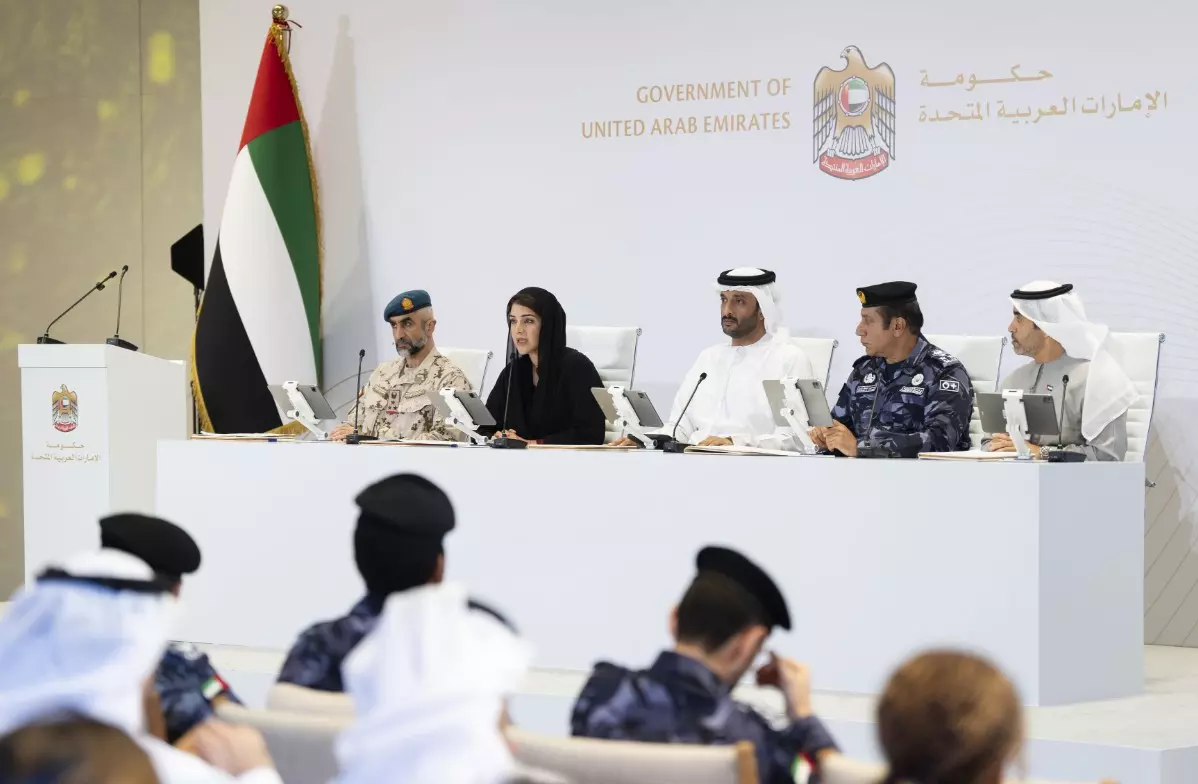

The UAE Government on Tuesday set out the extent of recent attacks on the country and detailed the military, diplomatic and economic measures taken in response, during a joint media briefing in Abu Dhabi.
Senior representatives from the Ministry of Defence, Ministry of Interior, Ministry of Foreign Affairs, Ministry of Economy and Tourism and the National Emergency Crisis and Disaster Management Authority addressed the situation, presenting figures on interceptions, casualties and national preparedness.
Brig. Staff Pilot Abdulnasir Alhameedi, spokesperson for the Ministry of Defence, said that since the start of the Iranian attacks, UAE air defences have dealt with 186 ballistic missiles. Of those, 172 were destroyed, 13 fell into the sea and one landed داخل UAE territory.
A total of 812 drones were detected. Air defence systems intercepted 755, while 57 landed in the country. Eight cruise missiles were also detected and destroyed.
The attacks resulted in three fatalities and 68 minor injuries. Limited damage was recorded to certain civilian facilities. Officials said most of the recorded impacts were linked to interception operations rather than direct strikes.
Alhameedi said the Armed Forces remain at the highest levels of readiness. The UAE operates multi-layer air defence systems covering long-, medium- and short-range threats, supported by strategic munitions reserves to sustain operations. Reinforced deployments and enhanced early warning systems are in place across airspace, territorial waters and land borders.
The Ministry extended condolences to the families of those who lost their lives and said the country will not accept any violation of its sovereignty.
Reem bint Ebrahim Al Hashimy, Minister of State for International Cooperation, said the UAE and other Gulf Cooperation Council states were subjected to overt Iranian attacks during what she described as an unprecedented regional escalation.
She reiterated that the UAE’s territory will not be used for any military action against Iran. At the same time, she affirmed the country’s right to self-defence under Article 51 of the UN Charter.
The UAE has closed its embassy in Tehran, withdrawn its diplomatic mission and summoned the Iranian ambassador to deliver an official protest note. The country has also called on the UN Security Council and the wider international community to condemn the attacks and prevent recurrence.
Al Hashimy said continued escalation would affect political, economic and trade relations, adding that dialogue remains the only path to prevent further expansion of the conflict.
Minister of Economy and Tourism Abdulla bin Touq Al Marri said the national economy continues to operate normally.
Strategic reserves of essential goods are sufficient for four to six months, he said, with import flows continuing under diversified trade partnerships. Stock levels at 627 major outlets are monitored daily through a digital platform, and 420 inspection visits are being conducted during Ramadan to prevent unjustified price increases.
The General Civil Aviation Authority has activated emergency air corridors with a capacity of 48 flights per hour. Since March 1, 17,498 passengers have been transported on 60 national carrier flights. The next phase will see 80 daily flights carrying more than 27,000 passengers. The government will cover accommodation and subsistence costs for affected travellers.
Security and public services
Brigadier Abdulaziz Al Ahmad of the Ministry of Interior said the security situation across the Emirates remains stable. More than 3,200 specialised vehicles and over 4,100 patrols and rapid response units have been deployed under a system coordinated with more than 25 national entities.
Dr. Saif Juma Al Dhaheri of NCEMA said essential services, including energy, water, telecommunications, transport, healthcare and supply chains, continue without disruption. Education has shifted to distance learning to ensure continuity.
A joint national media cell has been activated to provide consistent updates, and the early warning system remains in operation.
Officials urged the public to follow instructions issued by competent authorities and to rely only on official sources for information. The government said safeguarding national security, public safety and economic stability remains its central priority.