
















Kerala LoP accuses CPI(M) of divisive politics on religious basis
text_fields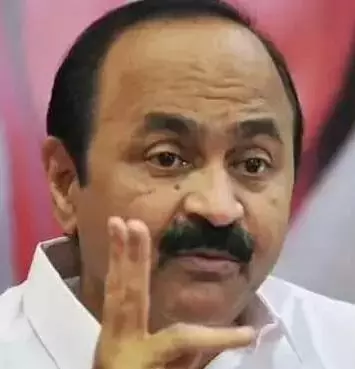

Kannur: V.D. Satheesan, Leader of the Opposition in the Kerala Assembly, strongly attacked the ruling CPI(M) on Friday for allegedly encouraging religious polarisation in the state, while reaffirming the Congress-led UDF's commitment to secularism and balanced administration.
Speaking to the media, he stated that community institutions such as the Nair Service Society (NSS) have the authority to make choices, but emphasised that the UDF's opinions are political.
He raised three pointed questions for the government: whether it is prepared to correct affidavits supporting ritual violations at Sabarimala, whether it will withdraw the thousands of cases filed against participants of the Namajapa procession, NSS activists, and political workers, and why it failed to withdraw cases before the Ayyappa Sangamam.
The Opposition leader accused the government of politically exposing “pseudo-devotees” during the Ayyappa Sangamam held at Pampa last week, IANS reported.
He noted that the event faced organisational challenges, with attendance far below the projected 4,200, and highlighted issues such as the disposal of half a million rupees’ worth of food and the exclusive display of Chief Minister Pinarayi Vijayan’s and other state leaders’ images on event banners, despite it being organised by the Devaswom Board.
He criticised the public reading of a message from Uttar Pradesh Chief Minister Yogi Adityanath by a state minister, interpreting it as CPI(M) facilitation of majoritarian political messaging.
He stressed that the UDF maintains cordial relations with the NSS and SNDP (the social wing of the Hindu Ezhavas) and rejects any attempts to introduce communal agendas.
“Our secular stance is consistent: we oppose divisive politics whether from minority or majority groups,” he said, noting that Kerala’s secular ethos remains a guiding principle for the alliance.
Highlighting the CPI(M)’s past alignment with the Muslim League and tolerance of extremist elements, he contrasted it with the UDF’s inclusive approach, asserting that the party will resist communal polarisation in the lead-up to the parliamentary elections and beyond.
He concluded by pledging that the UDF will maintain a firm, principled stance against communalism, uphold secular values, and continue to prioritise Kerala’s diverse social fabric over short-term political gains.