












Lok Sabha rejects Constitution amendment bill after failing to secure two-thirds majority
text_fields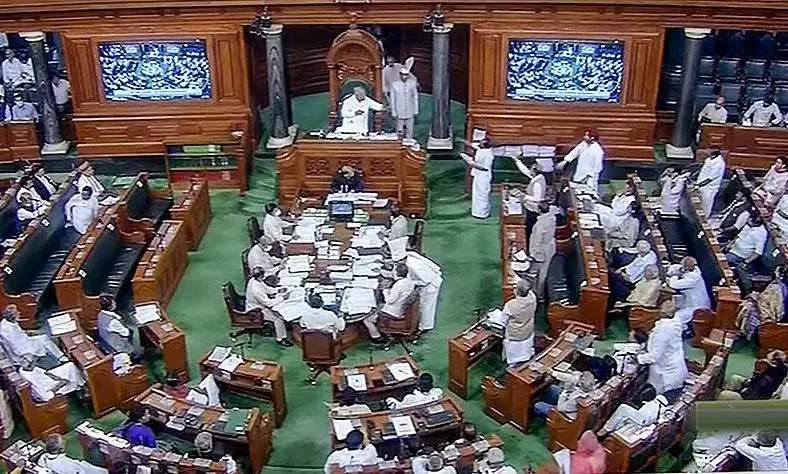

The Lok Sabha rejected the Constitution (One Hundred and Thirty-First Amendment) Bill, 2026, on 17 April after it failed to secure the required two-thirds majority. The Union government subsequently withdrew the associated Delimitation Bill, 2026, and Union Territories Laws (Amendment) Bill, 2025.
The three-bill package aimed to raise the Lok Sabha's strength to 850 seats and enable women's reservation by decoupling it from delimitation tied to the forthcoming 2027 Census. Of 489 members present and voting, 278 supported the measures while 211 opposed them—no abstentions were recorded. A constitutional amendment demands at least two-thirds approval among those voting, or 326 votes in this instance.
Tamil Nadu Chief Minister MK Stalin hailed the outcome as "Tamil Nadu Defeats Delhi!" Congress leader Rahul Gandhi described the bill as unconstitutional, attributing its defeat to that flaw.
Opposition came from parties including DMK, YSRCP, BRS, Congress, and the Left, who argued that census-linked delimitation would erode southern states' parliamentary representation. Ahead of the vote, Union Home Minister Amit Shah offered to amend the bill explicitly for a uniform 50% seat increase across all states, preserving existing proportions based on the 1971 Census.
He illustrated with Tamil Nadu's case: its current 39 seats would become 59 under the proposal—20 reserved for women and 39 open—maintaining the prior total of open seats despite population-based adjustments. "If we give 33% reservation to women in the existing 543 seats, as DMK says, 13 seats in TN will be reserved for women, and 26 seats will remain open. If we go by the 2011 Census population, TN will get six seats fewer," Shah explained.
Amid southern MPs' demands for written assurances over oral pledges, Shah proposed halting proceedings for an hour to table the amendment. Yet no such change materialised, and voting proceeded. He accused the INDIA alliance of stalling women's reservation under the guise of implementation worries, while rejecting calls to revert delimitation to the 2027 Census as a delay tactic.
DMK MP Kanimozhi condemned the bills as "the single greatest assault on the Indian federal structure," masquerading as women's reservation measures. She highlighted vague provisions in the constitutional bill as evidence of "non-application of the mind, or a mind determined to push its own agenda."