















17 years after Batla House encounter: Jamia students questioning point-blank shooting face police's heavy hand
text_fields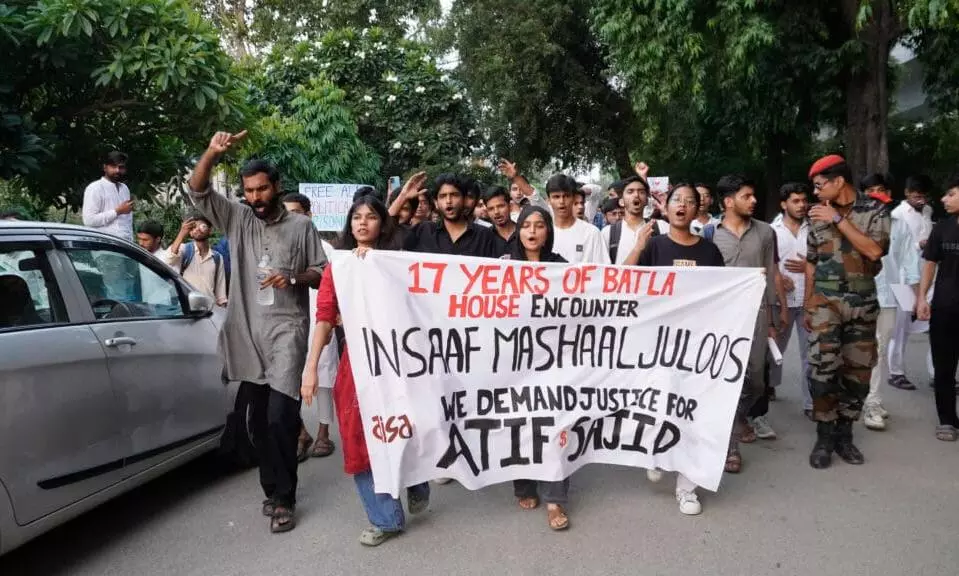

Remembering the 2008 Batla House encounter that killed two Muslim youths after branding them as Indian Mujahideen members, the All India Students’ Association (AISA) alleged that their peaceful protest inside the Jamia Millia Islamia campus was met with the heavy hand of the Delhi Police in connivance with the university administration, as female students were also dragged, manhandled, and detained, while the whereabouts of several detainees remain unknown.
The march, organised under the banner “Insaf Mashaal Juloos,” moved from the Central Canteen towards Gate No. 7 but was abruptly halted when security forces, supported by the university’s own guards, blocked students and allowed the police to pull them out of the campus, according to Maktoob Media.
AISA leaders and several activists were detained in the process, with students reporting that female protesters were grabbed roughly, their clothes torn, and in one case, a hijab-clad student was dragged away by women guards. Others alleged that the gate was deliberately left open, providing the police easy access to snatch demonstrators, and some recalled being detained even inside the campus.
For the student activists, the crackdown symbolised more than just a policing measure, as their experience of being beaten, pulled by the hair, and shoved into vehicles deepened their conviction that neither the government nor the university wished for the scant remembrance of the Batla House incident to survive.
The protest revived focus on the Batla House encounter, which remains deeply controversial even seventeen years later. Conducted on 19 September 2008 during Ramadan, the Delhi Police Special Cell stormed a flat in the Batla House locality, claiming it was harbouring Indian Mujahideen operatives linked to the Delhi serial blasts.
In the ensuing operation, 24-year-old Jamia student Atif Amin and 17-year-old Jamia School aspirant Mohammad Sajid were killed, while Inspector Mohan Chand Sharma also lost his life. Although the police declared the operation genuine, demands for an impartial judicial enquiry arose immediately, yet none has been ordered to this day.
Civil rights organisations, including PUDR, PUCL, Jan Hastakshep, APCR, JTSA, and FDI questioned the official narrative through fact-finding reports that pointed to grave inconsistencies. Sajid’s wounds on the top of his head suggested execution, Atif’s back bore peeled skin indicating torture, and both bodies carried blunt injuries inconsistent with a crossfire.
Critics also highlighted the implausibility of two suspects escaping from a flat with only one exit, while noting that Inspector Sharma had entered without a bulletproof vest despite intelligence warnings. Despite these concerns, the National Human Rights Commission in 2009 accepted the police version without conducting its own investigation.
Further doubts were raised when RTI applications revealed post-mortem reports confirming that Atif and Sajid suffered blunt force assaults before being shot, and inconsistencies persisted in the placement of bullet wounds, particularly the fact that all of Sajid’s entry wounds were on his back. These findings suggested the possibility of torture and execution, strengthening suspicions that the encounter was staged rather than an open exchange of fire.
The impact of the encounter extended far beyond the two deaths, as it reshaped the lives of Muslim students across Delhi, particularly those of Jamia Millia Islamia. Several Muslim youths were rounded up, interrogated, or detained in the weeks that followed, with their families stigmatised, careers disrupted, and futures left in ruins.