

















Five baby orangutans rescued in Odisha, leads to wildlife trafficking probe
text_fields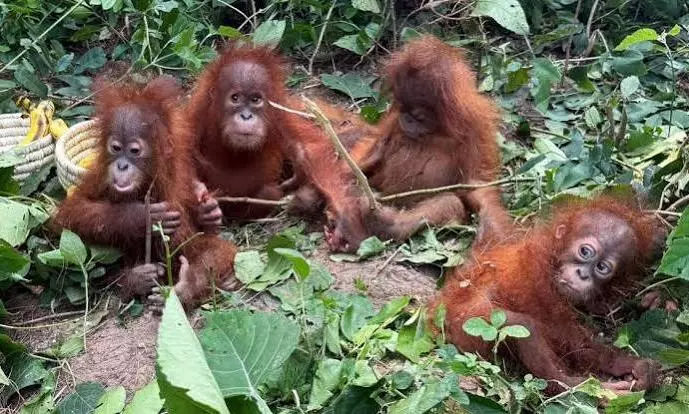

Five baby orangutans have been rescued from a forested area in Odisha, thousands of kilometres from their natural habitat in Southeast Asia.
The discovery has prompted authorities to investigate how the animals reached India.
The juveniles were found in a casuarina plantation in the Udayapur-Talsari area of Balasore district. Wildlife officials suspect they may have been brought into India illegally, although the circumstances remain under investigation.
The orangutans have been shifted to Nandankanan Zoological Park in Bhubaneswar, where they are being kept in quarantine and undergoing veterinary examinations.
Odisha Forest and Environment Minister Ganesh Ram Singhkhuntia said each animal could fetch around Rs 20 lakh to Rs 25 lakh in international markets, raising concerns that they may have been part of an illegal wildlife-trafficking operation. Officials are examining whether the animals could have been transported into Odisha by air, water or rail.
Orangutans are great apes belonging to the genus Pongo and are not monkeys. They are the only great apes naturally found in Asia and are known for their long reddish-brown hair, extremely long arms and adaptations to life in trees. They are generally solitary, with mothers and their young forming their most important long-term social relationship.
Wild orangutans are found only on the Southeast Asian islands of Borneo and Sumatra. Scientists recognise three living species: the Bornean, Sumatran and Tapanuli orangutans. Authorities have not yet established which species the five rescued animals belong to.
Orangutans primarily eat fruit but also consume leaves, flowers, bark, insects and other vegetation. Their populations face threats from deforestation, logging, agricultural expansion, fires, hunting and illegal wildlife trafficking, with palm-oil plantations contributing to habitat loss in parts of their range.
Infants are particularly vulnerable to the illegal pet trade. Their slow reproductive rate also means populations struggle to recover when adults or young animals are removed from the wild.