











Disagreement over beliefs no ground for suppression: Justice Ujjal Bhuyan
text_fields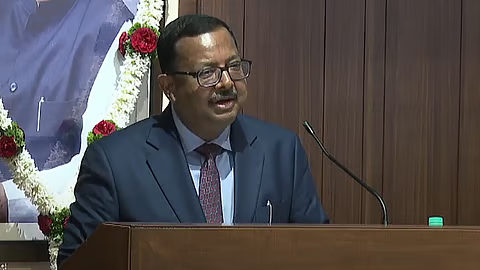

New Delhi: Disagreement over one’s beliefs or ideology cannot justify their suppression, Supreme Court Justice Ujjal Bhuyan has reportedly said, emphasising that tolerance requires acceptance of multiple viewpoints and protection of dissenters from coercion.
Speaking at the Smt Nirmala Devi Bam International Moot Court Competition organised by the Indore Institute of Law, Justice Bhuyan said an intolerant society can neither be progressive nor inclusive, according to a report by LiveLaw.
He stated that intolerance stems from a “dogmatic conviction about the rightness and superiority of one’s own beliefs over others”, which undermines reason. “An intolerant society can never be a progressive, inclusive society,” he said, adding that dissenters must be protected from “coercive state and non-state actors, especially those led by fanatical, intolerant groups”.
Justice Bhuyan added that freedom of speech and expression enables marginalised and excluded groups to participate in shaping constitutional culture and democratic discourse. He noted that the true test of justice, liberty, and equality lies in the lived experiences of the marginalised rather than the privileged.
He further said that tolerance flows from the Constitution’s Preamble and its commitment to fraternity, while intolerance arises when ideological rigidity replaces reasoned dialogue.
His remarks come amid growing concerns over declining freedom of speech and press freedom in India, including social media takedowns of posts critical of Prime Minister Narendra Modi and legal actions against comedians and other dissenting voices.
The judge had also recently advocated for free speech while hearing a petition against the film Ghooskhor Pandat, stating that freedom of expression “cannot be suppressed on account of threats of demonstration and processions or violence”, as that would amount to a “surrender to blackmail and intimidation”.
Earlier in February, Justice Bhuyan had also said that intolerance is dangerous both to democracy and to individuals. He stressed that state or non-state actors cannot “vilify and denigrate any community” based on religion, caste, or region through any medium.