










Centre objects to English being classified as an indigenous language
text_fields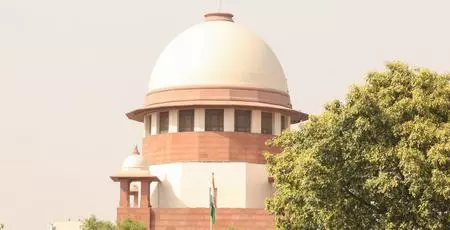
Photo: IANS

New Delhi: The Union government on Wednesday, September 9, told the Supreme Court that it had reservations about treating English as an indigenous Indian language. It also informed the court that consultations would be held soon on whether students currently studying in Class 6 could be given a one-time exemption from the mandatory third-language Board examination.
The matter came up before a bench headed by Chief Justice of India Surya Kant. Senior advocate Gopal Sankaranarayanan, appearing for the petitioners, sought directions from the court regarding the classification of English as a non-native or foreign language, The Wire reported.
Solicitor General Tushar Mehta, representing the Centre, said the government had concerns about the issue and wanted an opportunity to present its position. He indicated that a meeting with the relevant officials would be held either on Wednesday or Thursday, with Additional Solicitor General Aishwarya Bhati participating in the discussions.
The Centre requested a short adjournment because ASG Bhati was unable to appear before the court due to a personal difficulty. The government said it would use the additional time to consult the concerned authorities and arrive at a decision.
Justice Joymalya Bagchi observed that adequate time would be necessary not only for students to adjust to the proposed language requirements but also for educational infrastructure across different boards to become sufficiently prepared.
The judge also indicated that introducing a mother tongue, followed by another indigenous language and then an additional indigenous or foreign language, could be a sound educational approach if introduced at a younger age. Starting the process earlier, he noted, would give children more time to adapt to the language requirements.
The Supreme Court had raised the issue in July while examining the three-language policy. The court questioned whether English, given its widespread use in India over many decades, could reasonably be treated as a non-indigenous language.
On July 14, Justice Bagchi had also pointed out that the term “native”, used by the Central Board of Secondary Education (CBSE) in connection with its three-language policy, was significant because the word does not appear in either the Constitution or existing statutes.
The CBSE curriculum issued in April stated that its three-language formula would be introduced gradually from Class 6 onwards. Under the policy, students are expected to study three languages, including two languages considered native to India.
The policy has triggered concerns in several parts of the country, particularly in southern India, where critics fear that its implementation could result in the indirect imposition of Hindi on students.