
















Senator Chris Murphy warns US missile stockpiles dangerously depleted by Iran war
text_fields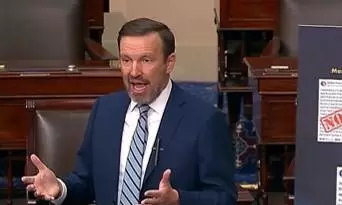

Washington: Democratic Senator Chris Murphy has warned that the United States is in a vulnerable national security position after expending "almost all" of its interceptor missiles and a majority of its Tomahawk stockpile during nearly five months of conflict with Iran.
Speaking on NBC’s Meet the Press, the Connecticut senator, who serves on the Senate Appropriations Committee, argued that depleted munitions have compromised U.S. defense capabilities and emboldened geopolitical rivals.
“We have put the United States in a dangerous position,” Murphy said. “We have allowed Russia and China to imagine things that they couldn’t have imagined earlier because of our inability to defend ourselves and our allies.”
The warning comes as the Pentagon requests an additional $67 billion in defense funding, partially aimed at replenishing military stockpiles. President Donald Trump addressed the supply concerns in remarks aired on the same program, acknowledging that while inventory for certain powerful munitions remains virtually unlimited, supplies for other weapon categories are "a little bit tighter."
Murphy stated he will oppose additional funding while the conflict continues, though he expressed willingness to support a replenishment package once fighting stops. Prioritizing an end to the war and the reopening of the Strait of Hormuz to stabilize American energy prices, Murphy noted he would even accept a flawed compromise.
“I am prepared to support a bad deal to end this war and reopen the Strait, because the only deal that is available at this point in time is a terrible bad deal,” Murphy said.
Republican Senator Jim Banks offered a contrasting defense of the administration's military strategy, arguing that the campaign has successfully degraded Tehran's capabilities.
Banks asserted that U.S. forces have dismantled "85% of Iran’s ballistic missiles [and] defense industrial base," effectively blocking the regime's path to a nuclear weapon. He added that a U.S. naval blockade has severely impacted Iran's economy and that the administration's decisive actions would ultimately establish long-term deterrence.
Meanwhile, economic officials are working to mitigate the domestic impact of the conflict. National Economic Council Director Kevin Hassett told CNN that the U.S. Navy is actively escorting vessels out of the Gulf. To manage domestic energy costs, the administration has expanded U.S. oil production and issued a Jones Act waiver to ship Gulf Coast oil directly to the East and West coasts. Hassett voiced confidence that energy prices would fall significantly once the regional conflict resolves.
(IANS)