

















Nepal floods kill 472, Himalayan glacier reports warned of accelerating ice loss months before
text_fields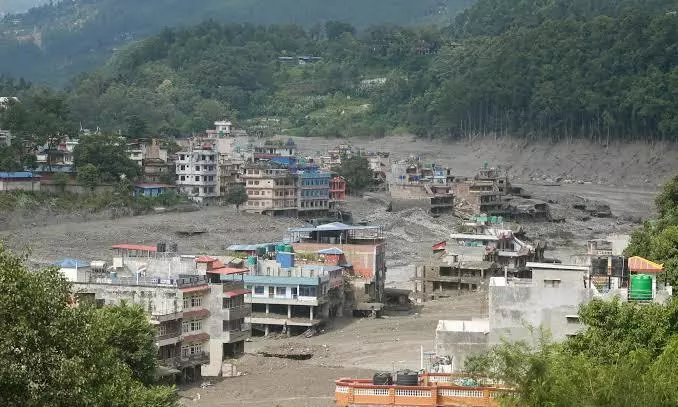

At least 472 people have been killed, and 1,468 remain missing after massive flash floods swept through communities along the Nepal-China border this week.
Indians account for the largest number of missing foreign nationals. Nepal's tourism board data showed 178 Indians were missing, while 11 others had been rescued. Many of those missing are foreign tourists, including trekkers in Nepal and Hindu pilgrims travelling to Tibet's Mount Kailash.
New satellite imagery from Vantor showed the Tibet-Nepal Rasuwagadhi border crossing had been destroyed, with floodwaters scouring the valley floor. Aerial footage also showed a lake forming and expanding near the border.
Himalayan glacier reports warned of accelerating ice loss months before deadly floods in Nepal.
Warnings issued months earlier pointed to rapidly accelerating glacier loss across the Hindu Kush Himalaya, raising fresh concerns about the region's vulnerability to extreme flooding and landslides.
Two reports published in March by the International Centre for Integrated Mountain Development (ICIMOD) found that glacier wastage in the Hindu Kush Himalaya had doubled since 2000. Between 1990 and 2020, glaciers across the region lost about 12 per cent of their total area and nine per cent of their estimated ice reserves.
The HKH Glacier Outlook 2026, which analysed 38 monitored glaciers, warned that parts of the Himalayan cryosphere could be nearing critical tipping points towards irreversible retreat. ICIMOD also said up to 27 metres of glacial ice thickness had been lost since 1975.
The reports warned that the changes posed risks to nearly two billion people downstream who depend on water from the region's glaciers.
Researchers are investigating whether an ice-rock avalanche from a high-altitude area triggered the floods. Scientists have also pointed to warming temperatures causing rain instead of snow at elevations above 4,000 metres. Reduced snow cover, retreating glaciers and degrading permafrost can leave mountain slopes more vulnerable to sudden failures.
Meanwhile, China has warned that a barrier lake formed near the Nepal border could breach. The lake contained about two million cubic metres of water on Thursday, with inflows potentially adding another three million cubic metres within three days.
ICIMOD said the Hindu Kush Himalaya contains more than 63,700 glaciers covering over 55,000 square kilometres and feeds 10 major river systems in Asia. At least 78 per cent of the glacier area between 4,500 and 6,000 metres is highly exposed to elevation-dependent warming.