













Nobel Prize in Physics 2026 awarded to Francis Halzen for neutrino research
text_fields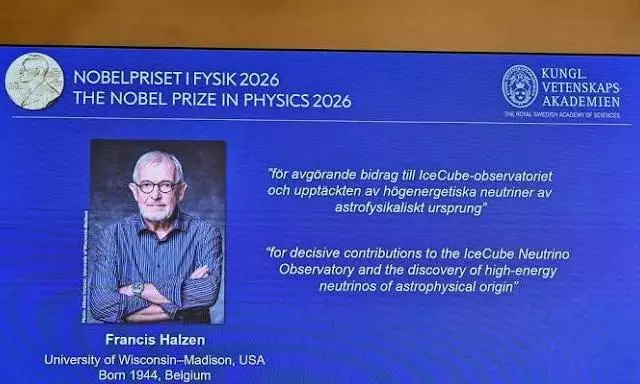

The 2026 Nobel Prize in Physics has been awarded to Belgian physicist Prof. Francis Halzen for his decisive contributions to the IceCube neutrino observatory and the discovery of high-energy neutrinos of astrophysical origin.
Halzen, a particle physicist at the University of Wisconsin-Madison, led the work on the IceCube detector at the South Pole. The observatory made the first detection of high-energy extraterrestrial neutrinos in 2013.
IceCube uses thousands of basketball-sized light detectors embedded in a cubic kilometre of Antarctic ice to detect faint flashes produced when neutrinos collide with atomic nuclei. Halzen had proposed converting part of the South Pole ice into a neutrino observatory in 1988.
Neutrinos are extremely elusive particles that pass through almost all matter. However, they can occasionally interact with atomic nuclei, producing signals that sensitive detectors can record. The South Pole offered clear ice and a location largely free from sources of interference and seismic vibrations.
Following the 2013 discovery, IceCube scientists identified the first cosmic source of neutrinos, located 3.7 billion years away. The findings have opened a new form of astronomy, allowing scientists to study the universe using neutrinos alongside light, other electromagnetic radiation and gravitational waves.
Halzen, who received the news while travelling in Italy, said he hoped the prize would help secure approval for a new research proposal. He also credited the researchers who joined the project in its early stages.
The prize carries an award of 12 million Swedish kronor, about £900,000.
Dr Patrick Dunne of Imperial College London said detecting astrophysical neutrinos had opened “a new lens” for observing the universe.
Other major neutrino experiments include DUNE in the US and Hyper-Kamiokande in Japan.