
















ISRO successfully tests Gaganyaan capsule parachute system, marks major milestone for human spaceflight
text_fields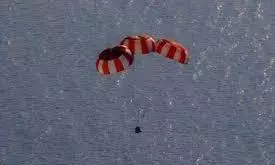

India achieved another milestone in its journey toward human spaceflight with the successful test of the Gaganyaan capsule’s parachute system.
On November 3, the Indian Air Force carried out a high-altitude drop of a 7.2-tonne dummy capsule from an IL-76 aircraft at approximately 2.5 km over Uttar Pradesh.
The test verified the capsule’s complex parachute deployment sequence, a critical step in ensuring crew safety during landing.
According to ISRO, the Gaganyaan module uses a system of 10 parachutes. These include two chutes to release the cover, two drogue chutes to stabilise and slow the module, three pilot chutes to pull out the main ones, and three main parachutes to ensure a safe landing.
The November 3 test intentionally simulated an “off-nominal” scenario by deploying only two of the three main canopies. This created an uneven load to test the limits of the system under stress. Officials stated that “the parachute system deployed as planned and the sequence was executed flawlessly,” which resulted in a stable descent and soft touchdown.
ISRO described the trial as a key step toward qualifying the parachute system for future human missions.
The success of this test reinforces the reliability of the system designed to protect astronauts during re-entry and landing.
The agency will now conduct additional tests as part of its roadmap toward India’s first crewed mission. Three uncrewed Gaganyaan flights are scheduled, each carrying a humanoid robot named Vyomitra, meaning “space friend,” to collect essential data.
If these missions proceed as planned, Indian astronauts could embark on their first Gaganyaan flight by early 2027. ISRO called the recent drop test “an important milestone towards the qualification of the parachute system for human spaceflight,” underscoring its critical role in ensuring mission safety.