

















Astronomers detect long-predicted cosmic wind from Milky Way's central black hole
text_fields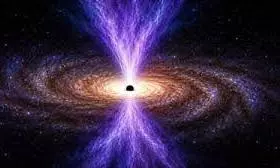

Astronomers have found the first clear evidence that the Milky Way's supermassive black hole, Sagittarius A, is generating a powerful hot wind, confirming a prediction that scientists have investigated for more than five decades.
The discovery is based on observations of a large cone-shaped cavity near Sagittarius A.
Researchers believe the structure was created by an energetic wind erupting from the black hole.
Scientists used data from the Atacama Large Millimetre/Submillimeter Array (ALMA) in Chile and NASA's Chandra X-ray Observatory to study the region around the black hole.
The observations revealed a cone-shaped area where cold gas, made up of carbon monoxide, is largely absent. At the same location, X-ray data showed the presence of hot gas. Researchers concluded that a hot wind from Sagittarius A likely swept away the cold gas or heated it, creating the cavity.
According to long-standing theories, black holes that consume surrounding gas should also eject some material back into space through winds or jets. While such outflows have been observed around other black holes, evidence of a wind from the Milky Way's central black hole had remained elusive.
Using several years of detailed ALMA observations, astronomers mapped cold gas within a few light-years of Sagittarius A. After removing the bright radio emissions from the black hole itself, they identified the giant cavity pointing directly toward the object.
Researchers say the finding provides strong evidence that Sagittarius A is actively launching a large-scale hot wind into its surroundings.
The study was led by Mark Gorski and Lena Murchikova of Northwestern University. Their paper has been accepted for publication in The Astrophysical Journal Letters.