









Let’s start preparing for Doha today
text_fields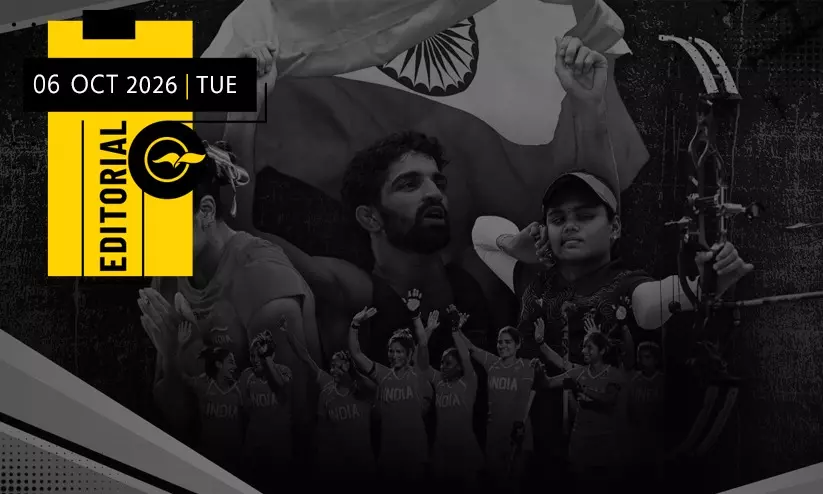

As the 20th Asian Games drew to a close in Aichi-Nagoya, Japan, China once again maintained its dominance, as usual. While Japan and South Korea secured the second and third positions respectively, India retained fourth place. However, in terms of the medal tally, India suffered a significant setback. India won seven fewer gold medals, while its overall medal haul was down by 21 compared with the previous edition. The inability of Indian athletes to shine in athletics, where much was expected of them, was a major reason for the decline in the country’s medal tally at these Games. This time, India managed to win just one gold medal on the track. Although India failed to hit the mark in shooting, which had delivered an impressive haul of gold medals last time, Neetu Danda’s two gold medals and Keralite athlete Vidarsh Vinod’s two silver medals were particularly notable. It was the sparkling performances of Indian athletes in archery, boxing and wrestling that helped the country retain fourth place. It cannot be said that India suffered a complete collapse in Aichi-Nagoya, but there is no denying that it suffered a severe setback.
The first thing to acknowledge when assessing the setbacks at the Games is that it was not the athletes, but the country’s sports policies that failed. The approach we have adopted in the name of a sports development action plan, is one that provides extensive support to only a few disciplines. It is difficult to deny that our authorities have treated many athletes representing the country on international platforms as second-class competitors. Take the case of Tamil Nadu’s Bhanika Elangovan, who won India’s first-ever medal in pole vault at the Asian Games. With airlines refusing to carry the poles she needed for the competition, she spent much of the time meant for final-stage training running around trying to resolve the issue. Her coach, Milbar Russell, has openly said that Indian Railways officials had repeatedly made them get off trains when they were travelling to attend training camps and competitions because they were not allowed to carry the long poles on trains. In other words, many athletes take to the field wearing the Indian jersey with exhausted minds and bodies, having had to struggle not against their opponents but against the systems in their own country. Injuries and poor physical fitness among athletes have also contributed significantly to the loss of medals, including in athletics.
The need of the hour is to begin meticulous and far-sighted planning, from today itself, for the next Asian Games to be held in Doha in 2030. A precise four-year roadmap must be drawn up. Instead of last-minute training camps, every athlete must be assured continuous overseas training and exposure. The Sports Ministry should establish a special ‘green channel’ for transporting sporting equipment such as javelins, poles and shooting guns, as well as for travel, or formulate a special protocol in coordination with the Ministries of Railways and Civil Aviation. Not a single athlete should have to face unnecessary pressures outside the field of competition. The support of modern physiotherapists and sports psychologists must be made available to all athletes to prevent injuries and help them recover from them. Sports science laboratories and data analytics systems should be put in place to accurately assess each athlete’s movements, speed and biomechanics by making use of the possibilities offered by new technology. It must be ensured that the situation in which crores of rupees are poured into sports and athletes in disciplines such as cricket, which have glamour and revenue potential, while several other sports are neglected on the pretext of a lack of funds, will not be repeated. Most importantly, there must be a willingness to bring athletes and sports enthusiasts who genuinely love sport into sports federations instead of packing them with political leaders and industrialists. This is a process more difficult than clearing a hornet’s nest.
Systems must be put in place to identify talented athletes at the school and university levels and provide them with scholarships and access to quality training facilities. Instead of offering rewards only after athletes win medals, those selected for national camps should be provided with insurance and job security. We do not want to be in a situation where we have to count and recount our losses after every major sporting event. All the mistakes made so far must be corrected before the Doha Games. For that, the entire country will have to step onto the field with determination.