













Priyanka Gandhi urges collective efforts to resolve man-animal conflict in Wayanad
text_fields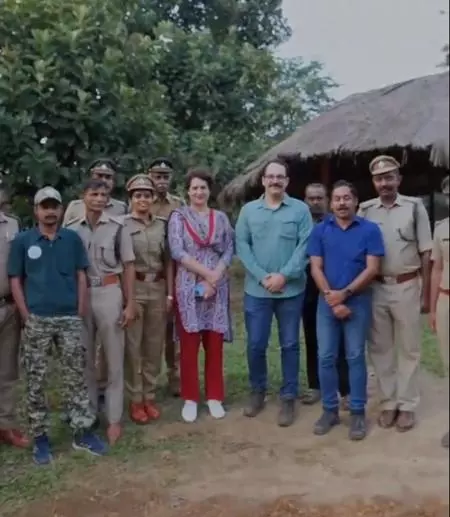

Wayanad: Wayanad MP and Congress General Secretary Priyanka Gandhi has emphasised the critical need for coordinated measures to address the district's escalating man-animal conflict, which is one of the most serious problems facing her area.
She recently travelled to Wayanad and visited the Muthanga Wildlife Sanctuary, where she met forest officials and veterinary surgeon Dr Arun Zacharia to learn about ongoing mitigation efforts.
In a post on X on Tuesday, Gandhi said that Dr Zacharia’s extensive experience with wild animals, the forest, and related issues was crucial to managing the crisis.
She noted that his knowledge, combined with the efforts of forest officials, played a key role in understanding the intricacies of the conflict and framing practical solutions, IANS reported.
The MP was briefed about the use of Kumki elephants—trained elephants deployed to drive away wild tuskers that stray into human settlements—as an important part of the response mechanism.
"Their role is vital in minimizing damage and preventing tragedies when elephants cross into inhabited areas," Gandhi wrote.
Wayanad, known for its rich biodiversity and extensive forest areas, has witnessed increasing incidents of human-wildlife encounters in recent years.
Straying elephants and other animals have caused damage to crops and property, while also leading to a spate of human casualties.
Several lives have been lost in the district due to such incidents, sparking widespread concern and demands for stronger preventive measures.
Gandhi, who has already raised the issue in the Lok Sabha, said the problem could not be solved in isolation.
"Man-animal conflict in Wayanad is a complex problem for which all of us have to collaborate and find workable solutions," she pointed out.
Her remarks underline the need for coordinated action involving local communities, experts, and government agencies.
The MP’s intervention is expected to add momentum to ongoing discussions on balancing conservation priorities with the safety and livelihoods of residents in the ecologically sensitive region.