


















New UGC rules leave EWS students unprotected: IIM professors
text_fields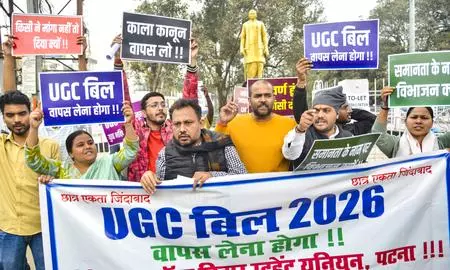
IANS photo.

Udaipur: The University Grants Commission’s (UGC) 2026 regulations aimed at “promoting equity” in higher education have come under sustained academic scrutiny, not only for their alleged vagueness but also for deep 'internal inconsistencies' that 'risk excluding' the very groups they claim to protect, IANS reported.
An essay authored by IIM Udaipur professors Kunal Kamal Kumar and Gyanesh Raj argues that the regulations suffer from a serious lack of coherence -- particularly in their treatment of the Economically Weaker Sections (EWS).
Released on January 13, 2026, the regulations explicitly name EWS as a vulnerable constituency in their objectives. However, the operative provisions ‘fail to translate this recognition into actionable protection’. As the essay points out, the definition of “discrimination” under Regulation 3(1)(e) is restricted to religion, race, caste, gender, place of birth, and disability. Economic disadvantage -- despite being the defining feature of EWS -- is conspicuously absent, it says.
This omission, the authors argue, is not a minor drafting error but a structural flaw. “EWS is named as a constituency, but not clearly operationalised as a basis of actionable discrimination,” the essay notes. As a result, individuals from the EWS category would have found it nearly impossible to file complaints against discrimination rooted in poverty, inability to pay fees, or class-based exclusion, the essay maintains. Such grievances would only become cognisable if they could be reframed under another listed ground, such as caste.
The essay highlights a striking inconsistency in the regulatory architecture. Eligibility for Other Backward Classes (OBC) reservation is already filtered through the “creamy layer” exclusion, which relies explicitly on socio-economic criteria, says the essay. It adds that Indian law, therefore, already recognises economic status as relevant in determining vulnerability and entitlement to remedial measures. Yet, the UGC regulations fail to extend this logic to EWS, even while naming it as a protected group, the authors argue.
This mismatch sends mixed signals and undermines the regulations’ stated equity goals, they say. It risks rendering class-coded humiliation and exclusion invisible within institutional grievance mechanisms, effectively leaving economically disadvantaged students without meaningful recourse, they point out.
Titled From 'Constable' to Fraternity: Ambedkar’s Design Lens for the UGC Regulations, 2026, the essay also critiques the guidelines for ‘deviating’ from B.R. Ambedkar’s principles. While public outrage largely focused on the exclusion of general castes from the definition of caste-based discrimination, the authors contend that gaps like the EWS anomaly reveal deeper design failures.
The Supreme Court of India stayed the regulations on January 29, citing vagueness. The essay suggests that unless such internal contradictions are addressed, future equity frameworks may continue to falter -- not due to lack of intent, but due to flawed legal imagination.