













Bangladesh in 'grip of fear', says Sheikh Hasina; vows return by yr-end
text_fields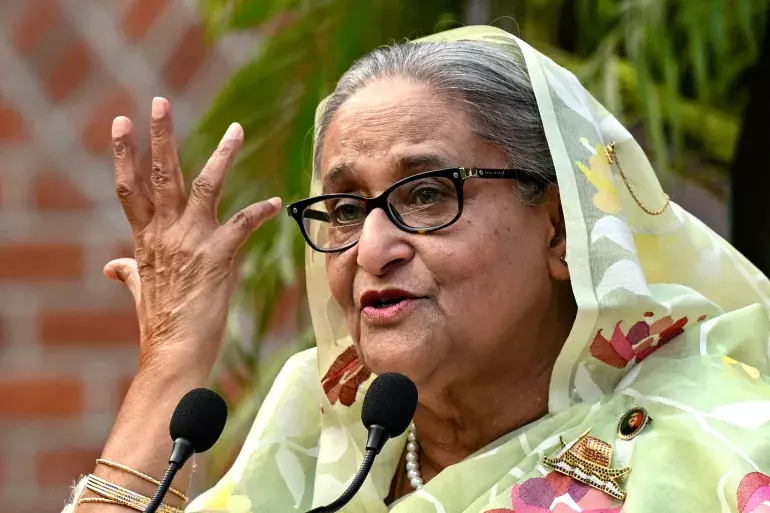

New Delhi: Former Bangladesh Prime Minister Sheikh Hasina on Wednesday claimed that Bangladesh has deteriorated over the past two years, with people continuing to live in an atmosphere of fear, insecurity and economic hardship despite the Bangladesh Nationalist Party (BNP) coming to power after what she described as a "rigged election".
Addressing a press conference in New Delhi via an audio link, Hasina, who has been living in exile in India for the past two years, also announced that she would return to Bangladesh by the end of the year.
"Even after a rigged election brought the BNP to power, the situation did not change. Bangladesh remains in the grip of fear, terror, depression, economic hardship and deep insecurity," she said.
Hasina became emotional several times during the address as she reflected on developments in Bangladesh over the past two years, saying she had watched her "beloved Bangladesh suffer".
Accusing organised groups of exploiting the July-August 2024 student protests for political ends, she claimed the movement was transformed from a campaign for reform into an instrument of violence.
"For the last two years, I watched my beloved Bangladesh suffer... This is not the Bangladesh we built; this is not the Bangladesh for which three million people sacrificed their lives in 1971. Let me begin with the truth about July and August 2024. It was not a peaceful student movement. From the beginning, my government tried to resolve the issue peacefully through dialogue, legal process and patience. But behind the language of reform, organised groups were working to turn students' demands into violent political instruments," she said.
Hasina said her government had attempted to resolve the protests through dialogue and legal means, alleging that the quota reform movement was deliberately turned into a campaign demanding her resignation.
"I personally took the initiative for dialogue with the students and invited them to Gonobhaban, the Prime Minister's residence. Three ministers also held discussions with them. A quota reform movement was turned into a one-point demand for my resignation. False propaganda was spread in a planned way. Genuine students were emotionally manipulated while organised groups used their movement as cover for violence and regime change," she said.
The former Prime Minister also referred to remarks attributed to Bangladesh's Chief Adviser Muhammad Yunus, claiming his description of the July 2024 protests as a "meticulously designed movement led by a mastermind" reflected the organised nature of the unrest.
"Muhammad Yunus himself said this was a meticulously designed movement led by a mastermind. His own words expose the truth. It was not simply a spontaneous student protest. There was no visible or responsible leadership. Instructions were given invisibly. It was organised, directed, and used to create a path to power outside the ballot box. From July 15, the character of the movement changed. Killings, arson, attacks and looting began. State property was destroyed," she alleged.
Hasina further alleged widespread political persecution over the past two years, claiming that at least 10,000 people had been killed or disappeared, 6.5 lakh arrested, and around 3,500 cases registered.
She said nearly 4.5 lakh Awami League leaders, workers and supporters had been named as accused, while more than one million others had been listed as unnamed accused. She also claimed that over 600 cases had been filed against her.
"Women activists of Chhatra League, Youth League and other affiliated organisations are facing abuse, humiliation and torture in custody. Many leaders and workers have also died in prison amid documented accounts of torture, denial of medical treatment, deprivation of food, negligence and denial of basic rights," she alleged.
Hasina claimed that the alleged persecution had extended beyond Awami League members to include minorities, judges, lawyers, intellectuals, cultural figures, journalists, professionals, workers, farmers, rickshaw pullers and ordinary citizens.
She further alleged that those who uphold the ideals of Bangladesh's 1971 Liberation War were no longer safe, claiming that Liberation War memorials had been destroyed and freedom fighters publicly humiliated.
"This is an attempt to erase the spirit of the Liberation War from Bangladesh. Muhammad Yunus himself spoke of pressing a reset button to wipe away the country's previous history. They want to erase the Liberation War, they want to erase Bangabandhu, they want to rewrite Bangladesh against the foundation on which it was born," she claimed.
Reiterating her intention to return, Hasina said she wanted to help restore Bangladesh's path of development and stability.

"The date of my return will be announced later. But I will return to my people," she said.
She also demanded that the ban on the Bangladesh Awami League be lifted, all cases against her and party members be withdrawn, and freedom of speech be restored in the country.
Concluding her address, Hasina said her return was aimed at serving the people rather than seeking power.
"They deserve a state that protects them, an economy that gives them opportunity, and a democracy that gives them rights. My return and the return of the Awami League to the democratic process is not about power. It is about putting Bangladesh back on the right track. It is about reviving the country's path of development, progress, secularism and stability. I want to return to Bangladesh for one purpose: to stand beside the people and help improve their lives. The people are the source of all power. I believe in them, I trust them, I love them, and I will return to them," she said.
With IANS inputs