















Trump’s ‘Board of Peace’ on Gaza seen as a trick to set a new world order
text_fields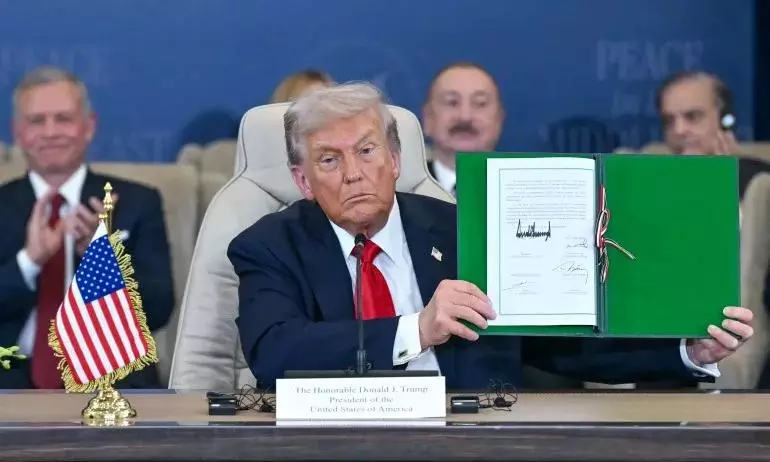

The US President Donald Trump’s invitations to countries, including India, to take part in the controversial “Board of Peace” initiative on Gaza have created a sense of suspicion among many countries, particularly in Europe, which view it as Trump’s trickery to bypass the United Nations and create his own world order in which he would be the final authority on global matters.
Though the initiative has been formed in the name of Gaza, nowhere in the charter of the initiative is Gaza mentioned, indicating that its scope extends far beyond the Palestinian enclave, while Israel has reportedly not been happy with the move, as Trump invited several countries, including Qatar and Turkey, to take part in Gaza’s rebuilding, even as India is yet to officially confirm its decision on the invitation.
India was among roughly 60 countries invited to join the proposed body, with US Ambassador to India Sergio Gor announcing on January 18 that a formal letter had been sent to Prime Minister Narendra Modi, inviting him to participate in what Trump described as a historic effort to reshape peace-building in the Middle East and beyond.
New Delhi has maintained public silence since the disclosure, and it is understood that officials are still assessing how participation would function, particularly given the initiative’s opaque governance structure and its implications for India’s long-standing support for multilateralism.
The charter, portions of which have been reported by international media, outlines the creation of a new international organisation and transitional governing authority, justified on the grounds that existing institutions have repeatedly failed to deliver a durable peace, a framing that has alarmed diplomats who see it as a direct challenge to the UN system.
European officials, in particular, have raised concerns that the board would concentrate political and financial power in the hands of its chair, a position reserved for Trump himself.
Further unease has been caused by provisions requiring countries seeking permanent membership to contribute up to one billion dollars, with the charter indicating that states making such contributions would be exempt from term limits, thereby entrenching a pay-to-stay model under presidential discretion. Trump has already announced a seven-member executive board dominated by Americans, alongside a separate Gaza-focused executive group that includes officials from Turkey, Qatar, Egypt and the UAE, as well as UN representatives.
Israel’s discomfort has been unusually public, with objections raised over the composition of the Gaza executive board and the lack of prior coordination, while criticism has also emerged within Israel over the inclusion of actors perceived as sympathetic to Hamas. At the same time, several US allies, including Argentina and Hungary, have swiftly accepted the invitation, while others, such as Turkey, Egypt, Jordan and Italy have said they are still examining the proposal.
For India, the decision carries particular diplomatic weight, as it comes amid sensitive trade negotiations with Washington following the imposition of steep US tariffs on Indian exports, and against the backdrop of Modi’s recent efforts to rebuild personal rapport with Trump after strains over regional security issues.
While India has historically supported Palestinian statehood, it has in recent years drawn closer to Israel, adopting a cautious UN voting posture that balances humanitarian concern with strategic restraint.
With Pakistan also confirming receipt of an invitation, and with the Board of Peace potentially setting precedents that weaken the UN’s role in conflict management, New Delhi faces a complex calculation, weighing immediate bilateral considerations against longer-term implications for global governance and India’s positioning within the Global South.