












Google Doodle celebrates Indian Biochemist Kamala Sohonie
text_fields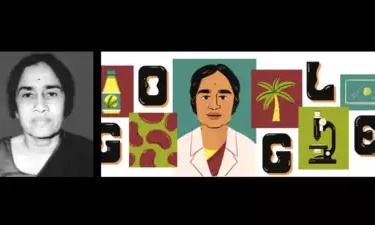

New Delhi: Dr Kamala Sohonie, the first Indian woman to receive a PhD in a scientific discipline in 1939 has been honoured by Google on her 112th birth anniversary.
Google on Sunday remembered her with a special doodle.
Sohanie received her PhD in the field of Biochemistry at a time when Indian women were prominently underrepresented in scientific disciplines.
The colourful doodle features her image alongside the letters of Google with the drawings of the microscope, glass slides, and her award-winning nutritious drink Neera.
From her work on potatoes, she discovered the enzyme 'Cytochrome C' which plays an essential role in the electron transport chain (the process by which energy is created for organisms), found in plants, human and animal cells.
Sohonie was born on June 18, 1911, in Indore, Madhya Pradesh. Her father, Narayanarao Bhagvat, as well as her uncle, Madhavrao Bhagvat, were chemists and alumni of the erstwhile Tata Institute of Sciences, which later became the Indian Institute of Science in Bengaluru.
She graduated in 1933 with a bachelor's in science from Bombay University. She became the first woman to be accepted into the Indian Institute of Science (IISc) in the same year, despite facing scepticism and gender bias. Her success opened doors for more women to enter the program at IISc.
She was invited to Cambridge University in the UK to work under Dr Derek Richter in the Frederick G. Hopkins laboratory. She returned to India in 1939 and was appointed professor and head of the department of biochemistry at Lady Hardinge Medical College in New Delhi.
Later, she worked at the Nutrition Research Laboratory, Coonoor as Assistant Director, focusing on the effects of vitamins.
She worked on the development of an affordable dietary supplement called Neera, made from palm nectar. The nutritious drink, rich with Vitamin C, proved to be a valuable resource for combating malnutrition among children and pregnant women.
She was awarded the Rashtrapati Award for her work in this subject.
According to The Times Of India report, Dr Sohonie introduced on-the-spot food quality tests at the Consumer Guidance Society of India show in an attempt to battle food adulteration. She had been subjected to a year-long quality test before she could enter a man’s world.
An active member of the Consumer Guidance Society of India (CGSI), she died in 1998.
With inputs from IANS