
















Ranji Trophy final: Harsh Dubey’s brilliance puts Vidarbha in control, Kerala’s fightback remains a threat
text_fields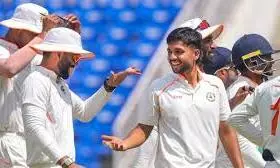

As the third day of the Ranji Trophy clash between Vidarbha and Kerala came to a close, the contrasting emotions on both sides were evident.
The Vidarbha camp, relaxed and jubilant, gathered on their team balcony, sharing laughter and light-hearted conversations.
In contrast, the Kerala contingent had made a quick exit, leaving behind scattered sheets of paper and empty bottles - perhaps symbolic of their dashed hopes.
Vidarbha’s confidence stems from their 37-run first-innings lead on a pitch that is steadily deteriorating. However, they remain cautious of Kerala’s ability to stage comebacks, a fact acknowledged by Harsh Dubey, who has now become the highest wicket-taker in a single Ranji season. “We definitely have a massive advantage, but Kerala has fought back in many matches this year. Anything can happen in cricket,” Dubey remarked.
Though the Jamtha track has yet to become a full-fledged turner, signs of its transformation are undeniable. The degree of turn has increased significantly, from 1.6 degrees on Day 1 to 4.2 degrees on Day 3, with further deterioration expected over the next two days. Several deliveries have already shown unpredictable behaviour - Dubey’s ball to Aditya Sarwate kicked up sharply, while a short-of-length ball from Darshan Nalkande to Sachin Baby skidded dangerously low. Parth Rekhade also extracted sharp bounce in the final session.
Dubey, well-acquainted with the conditions, anticipates the pitch becoming even trickier on Days 4 and 5. “The surface will still allow batting, but turn and bounce will increase. If someone bats well, they can score, but make no mistake—this pitch will turn,” he warned.
For Kerala, the best chance at revival hinges on the performance of their spin duo - Jalaj Saxena and Aditya Sarwate.
Though largely ineffective on the first day, both bowlers thrive on turning tracks and could prove lethal in the first session, where overnight moisture might create additional assistance. However, batting could become slightly easier once the ball softens, despite the wear on the pitch.
Vidarbha, on the other hand, plans to bat as long as possible, aware that setting a tall target for Kerala in the final innings would put them in a commanding position. The team has previously defended sizeable totals, and with the advantage of the first-innings lead, they are in prime position to do so again.
Vidarbha’s bowling attack was spearheaded by Dubey, who bowled a staggering 44 overs out of 125, constantly troubling Kerala’s batsmen with loop, drift, and deceptive arm balls. His ability to maintain tight lines and lengths saw him concede just seven boundaries throughout his spell.
The most crucial breakthrough came just before lunch, when Dubey dismissed Salman Nizar, Kerala’s key batter, with a cleverly tossed-up delivery that induced an LBW dismissal. It wasn’t as dramatic as Sachin Baby’s costly lapse in concentration, but it played a pivotal role in shifting the momentum firmly in Vidarbha’s favor.
The task ahead for Kerala is daunting.
History suggests that chasing on this surface is no easy feat. Mumbai managed 320 on a final-day chase, but that was on a black-soil pitch with a slower turn. In contrast, Gujarat, in 2022-23, was bowled out for just 54 while chasing a mere 74 on a similar surface, with Sarwate leading the charge.
To stand a chance, Kerala must find a way to counter Dubey’s increasing threat and avoid lapsing into rash decisions that have hurt them in the past. Their fate now rests in the hands of Saxena and Sarwate, who will need to deliver a spell of brilliance if Kerala is to stage a remarkable turnaround.