

















Bahubali lifts off, on course to reach Moon in 40 days
text_fields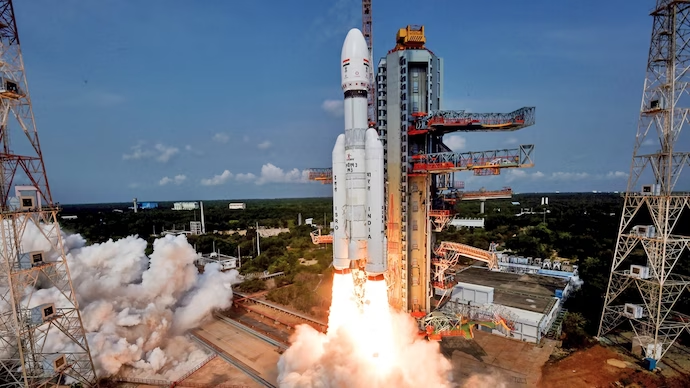

Sriharikota: India’s ambitious lunar mission Chandrayaan-3 has taken off to the azure world at the appointed time in the afternoon today at 2.35.
Scientists at India’s space research Organisation have been working over several weeks nonstop to fine tune the launch, keeping in mind previous mission’s partial failure.
As the time began ticking away to final moment, heavy excitement was brimming at the Satish Dhawan Space Centre in Sriharikota, Andhra Pradesh.
Scientists reportedly said that around 16 minutes after lift-off, propulsion module is expected to get separated from the rocket.
Subsequently, the rocket will orbit the earth for about 5-6 times in an elliptical cycle with 170 km closest and 36,500 km farthest heading towards the lunar orbit.
The follow-up to Chandrayaan-2, the third mission can demonstrate various capabilities including soft-landing on the lunar surface and using a rover to study the surface of the moon.
For days India’s Chandrayaan-3 has been in restive wait to climb skies to the Moon, bringing along aspirations of 1.5 billion humans that make up the most populous country on the planet.
India’s third lunar mission has gained huge international attention as India is becoming a major player in space technology.
Chandrayaan-2 didn’t work out as planned after its lander and rover couldn’t make soft-landing on the Moon.
A successful mission will give the distinction of being the fourth nation to land on the Moon.
The GSLV Mark 3 heavy lift launch vehicle, nick-named as Bahubali rocket, will carry the moon lander Vikram.
Renamed Launch Vehicle Mark 3 (LM-3), the GSLV, is half as high as Delhi’s Qutb Minar standing at 43.5 meters tall.
The rocket will travel over 40 days before it touch down on the Moon on August 23.
The Indian Space Research Organisation took great care of all paraphernalia involved in the mission after the last moon mission failed.
‘The main lacuna in the last Chandrayaan-2 mission was that there were off-nominal conditions that were initiated in the system. Everything was not nominal. And the craft was not able to handle the off-nominal condition for a safe landing,’ ISRO Chief S Somnath exclusively told NDTV.
This time the mooncraft will land in the South Pole of the moon, where India’s first mission found presence of water molecules triggering global interest.
Upon landing on the Moon, Vikram will then release the rover Pragyan to roam around the moon's surface for a lunar day equivalent of 14 earth days, conducting scientific experiments.