















Judiciary puts the brakes on ‘Orwellian dystopia’
text_fields

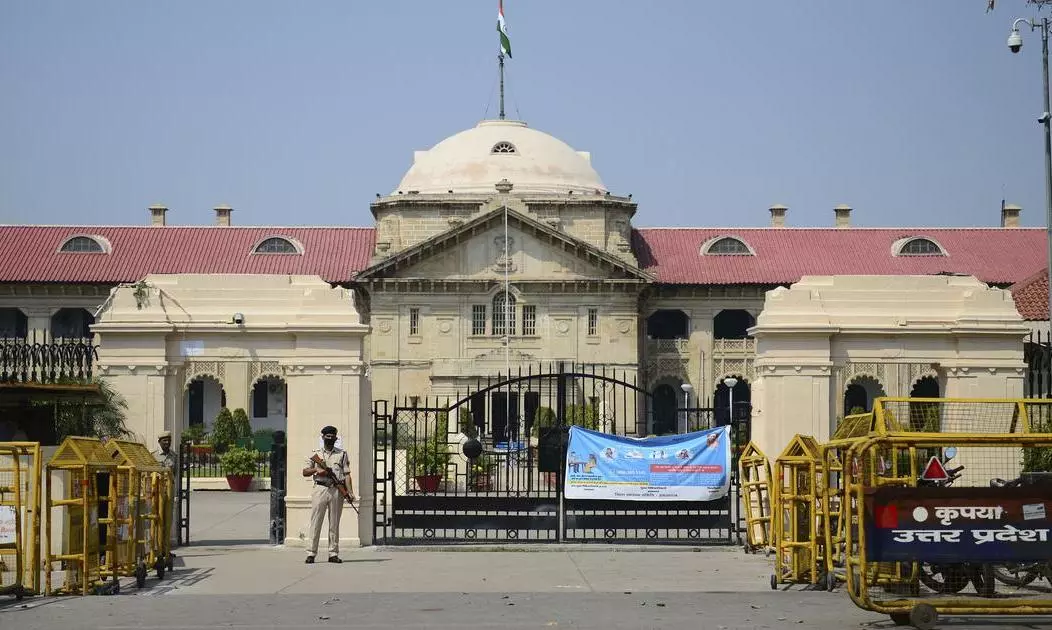
The Allahabad High Court delivered a landmark judgment last Monday, with a reference to 1984, the acclaimed novel by India-born British novelist George Orwell. The bench comprising Justices Atul Sridharan and Achal Sachdeva referred to Orwell’s dystopian vision while commenting on the arrest of a law student under the National Security Act. Orwell’s novel depicts the terrifying, anti-democratic nature of a totalitarian regime in which individual freedoms have no place. Expressions from the novel such as ‘doublethink', 'Big Brother is watching', and ‘Thought Police’ continue to feature in portrayals of authoritarian governments even today. The Allahabad High Court made the reference while criticising the arrest of law student Aakriti Chaudhary under the National Security Act. She was arrested in connection with allegations that she had called for violence during a workers’ protest in Noida, in April. The bench issued a strong warning that if such arbitrary actions continued, the state of Uttar Pradesh could eventually turn into an Orwellian dystopia. Although the High Court has quashed the arrest order issued under the NSA by the Gautam Buddh Nagar district magistrate against a student who has been in detention for five months and ordered her release, she may not be able to walk out of jail immediately. This is because several FIRs registered by the Noida police, apart from the five cases in which she has secured bail, are still pending against her. Twenty-four-year-old Aakriti Chaudhary is a law student at Delhi University. Like many others, she had gone to a workers’ protest in Noida to express solidarity with their demands which included an increase in the low minimum wage, limiting working hours from 10–12 hours a day to eight hours, and granting them a wage hike similar to that provided to workers in neighbouring Haryana. However, the authorities portrayed her participation as an attempt to incite violence and create unrest, including attacks such as the burning of vehicles.
The government, however, has not been able to produce concrete evidence before the court to substantiate these allegations. It is also worth noting that Chaudhary was arrested on April 12, a day before the alleged workers’ protest on April 13, even though the allegations against her were based on the protest. Another significant finding that emerged during the court’s examination was that the accused had not been served with the notice under Section 126 of the Bharatiya Nagarik Suraksha Sanhita (BNSS), which is required to be issued before a notice under Section 130. The court also found that the district magistrate had proceeded with the arrest hastily and at her own will. The bench observed that the protest in which Aakriti Chaudhary, who had been in detention for five months, participated was an activity permissible in a democracy. It noted that such protests serve as a “safety valve” for society and that suppressing an outlet for pent-up public anger could ultimately result in an explosion of that anger. The court further described the actions of district magistrate Medha Roopam - who is also the daughter of Chief Election Commissioner Gyanesh Kumar - as deserving derision. It ordered her, along with the other officials involved in the action, to personally bear a compensation of Rs 5 lakh for the hardships caused to Chaudhary as a result of their actions. The judiciary’s extraordinary and strongly worded order, along with its sharp observations, should serve as a lesson to the executive in general and, in particular to officials who exercise their powers arbitrarily or seek to win the favour of those in power. If officials are to understand the fundamental principle that there must be sufficient grounds before interfering with an individual’s liberty, perhaps such strong judicial reprimands are necessary.
Preventive detention under the extraordinary powers granted by the National Security Act is not something to be invoked indiscriminately. Law enforcement authorities must recognise that such a measure can be justified only when credible evidence establishes that a person is likely to commit an offence if not detained. One can only hope that judgments such as this, along with the financial penalty imposed, will help reinforce the understanding among those responsible for enforcing the law. The seriousness of the matter is further underscored by the court’s direction that, in addition to the fine, its adverse observations should be recorded in the service records of the officials found responsible. The government has failed to establish that Aakriti Chaudhary had engaged in any campaign or incitement that could have led to the acts of violence alleged by the police. The judiciary’s emergence as a guardian of citizens’ rights is a development that should elate those who value democracy. Law enforcement authorities must clearly distinguish between participating in a protest and creating anarchy in the process. If those who arbitrarily arrest people whenever they please are reprimanded by the courts for doing so, it will ultimately benefit society as a whole. Civil service is meant to uphold the Constitution and its values. Democratic governance can truly realize its spirit only when administrators understand that state power is not a weapon to be wielded according to personal whims or external influences. The Allahabad High Court’s judgment has once again served as a reminder of this fundamental lesson.