













'Free' nuclear powers
text_fields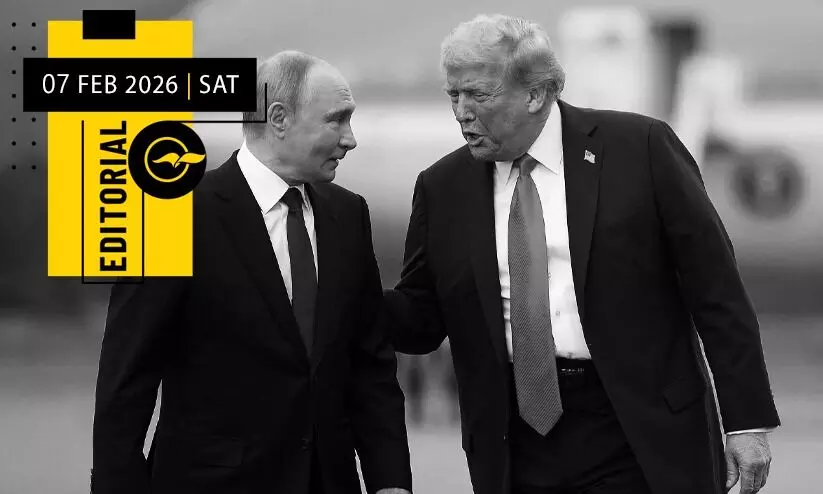

Two days ago, UN Secretary-General Antonio Guterres made an extraordinary statement. “The world is going through a grave moment. For the first time in more than half a century, we face a world without any binding limits on the strategic nuclear arsenals … the risk of a nuclear weapon being used is the highest in decades.” Guterres shared this concern with the world after the last nuclear non-proliferation treaty signed between Russia and the US, which together hold 80 percent of the world’s nuclear weapons, expired on February 4. The UN Secretary-General was referring to the agreement signed by then US President Barack Obama and Russian President Dmitry Medvedev in Prague, Czech Republic, on February 5, 2011. Under this treaty, known as New START (Strategic Arms Reduction Treaty) or the Measures for the Further Reduction and Limitation of Strategic Offensive Arms, the two countries agreed to limit the number and deployment of their nuclear weapons, including their nuclear arsenals. Accordingly, it was decided to cap the number of deployable warheads at 1,550 and limit missiles and bombers to 700. With the expiry of the agreement, there is now no control over the production and deployment of these weapons. This is probably the first time since the Nuclear Non-Proliferation Treaty came into force in 1970 that such a situation has arisen. And the politics of this is controlled by frenzied rulers. The complications created by this reality are reflected in Guterres’ words.
In 1991, the US and Russia signed the START treaty. It was an agreement to limit the number of nuclear weapons to 6,000. It can be seen as a continuation of the 1970 Nuclear Non-Proliferation Treaty. This was part of the objective to restrict nuclear energy to power generation and other uses, instead of weapons manufacturing. In that sense, it was a success. In 2012, when the agreement was nearing its end, negotiations for the New START treaty, which had begun in 2008, resulted in a decision to further reduce nuclear weapons. Until 2018, it can be said that both countries largely adhered to the agreement. However, after that, circumstances changed. Some observers note that the agreement began to weaken in 2017, when US President Donald Trump rejected Russian President Vladimir Putin’s proposal to extend it. It was around this time that Trump also announced the US withdrawal from the Intermediate-Range Nuclear Forces Treaty, which had been signed with the Soviet Union in 1987. When Joe Biden assumed office after Trump, some changes were evident. Discussions were held on extending the New START treaty. However, everything turned upside down with the start of the war with Ukraine. In February 2023 Putin announced that he was withdrawing from the New START treaty in protest against the US-NATO announcement that inspections of nuclear arsenals would be carried out. A few months ago, there was some speculation about whether Putin had reconsidered his stance. He stated that he was considering extending the treaty for a year. However, since Trump rejected this approach, concern has grown across the world. With the end of the New START treaty, the global community is now confronting the reality that there is no other framework governing the major nuclear powers.
Russia responded on Friday (February 6) that even though the agreement has ended, it will act responsibly. In one sense, this statement offers some reassurance. However, the White House’s position is that ‘If it expires, it expires’. It is clear that Trump will not heed Guterres’ call for the two countries to return to the negotiating table. Not only that, the US is also making an unusual demand to include China in any such agreement. It is true that in recent years, China has carried out large-scale nuclear weapons expansion. It is estimated that China currently possesses around 600 nuclear warheads. After 2023, they are reportedly developing an additional 100 weapons each year. In this context, it is a fact that peace cannot be secured through a US-Russia agreement alone. However, the US and Russia, which had committed to limiting their nuclear weapons to 1,550, are now expanding their arsenals. At present, the US has 1,770 nuclear warheads, with another 1,930 in reserve. For Russia, the figures are 1,718 and 2,591 respectively. In other words, all the major powers now have the 'freedom' to act without restraint amid intense competition in nuclear weapons expansion. For various reasons, the world today is overshadowed by wars and invasions. Guterres has described this moment as a ‘grave moment'. How the world will overcome this imminent phase remains to be seen.