










‘Peace on earth means peace in Palestine', Palestinian Christians forgo Christmas joy
text_fields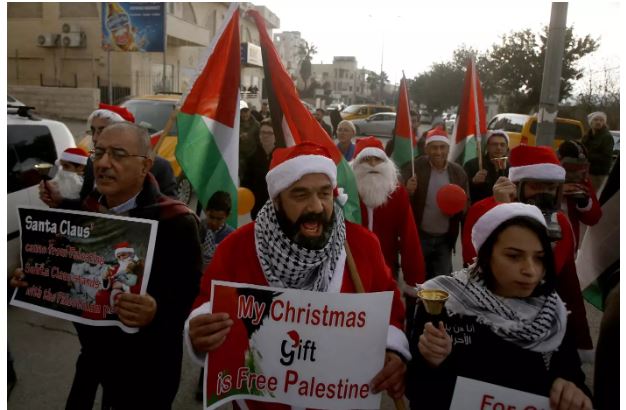

Palestinian American human rights lawyer Huwaida Arraf reflects the sentiments of many Palestinian American Christians who instead of adorning homes with Christmas festive lights chose not to celebrate Christmas in solidarity with Gaza.
As reported in Al Jazeera, Arraf has chosen a solitary sign in her front yard, bearing a sombre message that “Bethlehem cancelled Christmas because Israel is slaughtering Palestinians #GazaGenocide,” reflecting the agony felt by many Palestinian Christians this holiday season.
In the face of the devastating toll surpassing 18,600 lives in Gaza, Arraf, like numerous Palestinian Christians, has decided to forgo the traditional celebrations. Joy, if it can be found, is clouded by guilt, as the backdrop of atrocities in their homeland overshadows the joyous spirit of Christmas.
Arraf questions the world's ability to celebrate the birth of the "prince of peace" while atrocities against humanity unfold in the very place of his birth.
The United States witnesses a parallel sentiment among activists and Palestinian Americans, echoing the solidarity expressed in Palestine itself. Churches and Christian communities in Palestine have chosen to forgo Christmas celebrations as a mark of respect for the lives lost and a protest against the ongoing Israeli violence.
Even Bethlehem, the revered birthplace of Jesus in the occupied West Bank, experiences a subdued holiday season with quiet streets and dimmed decorations. The Lutheran Church in Bethlehem emphasizes the grim reality by displaying a nativity scene depicting Jesus born amidst the rubble, mirroring the destruction in Gaza.
Thousands of miles away, Palestinian and Arab Americans share the anguish and pain of their brethren. Nabil Khoury, a physician from southeast Michigan, articulates the incongruence of celebrating when family, friends, and countrymen are enduring a genocide.
The usual Christmas traditions, intimately tied to Palestine with holy places like the Church of the Nativity, become a painful reminder of the deep-rooted struggle against the Israeli occupation.
For Palestinian Christians like Khoury, the sense of national identity transcends religious differences. They view themselves as an integral part of Palestinian society, standing united with their Muslim brethren in the pursuit of liberation.
In Chicago, Husam Marajda, an organizer with the US Palestinian Community Network, reflects on the profound loss felt this holiday season. The festive spirit, typically marked by Christmas sweaters, family gatherings, and decorations, is conspicuously absent this year, replaced by a sense of emptiness and another day passing in the face of ongoing violence.
Despite the prevailing sombre mood, some, like Palestinian American activist Lexis Zeidan, are determined to preserve the essence of Christmas centred around faith and family. However, beneath the surface, anger and sadness simmer as the violence in Gaza continues unabated. Zeidan questions the lack of intervention to halt the bloodshed and criticizes elected leaders prioritizing political power over human life.
The narrative also touches upon the complex dynamic of evangelical support for Israel, despite documented abuses against Christians in Palestine. Some within the evangelical movement link the conflict to biblical prophecies, framing it within a theological interpretation that Zeidan rejects.
She emphasizes that supporting actions against Palestinians contradicts fundamental Christian principles such as "Thou shalt not kill" and "Thou shalt love thy neighbour."
Arraf, the human rights lawyer, rejects the use of religion to justify injustices and underscores the shared humanity of all victims, regardless of religious affiliation. As the conversation unfolds, her 9-year-old daughter, Mayaar, interjects with a poignant reminder: "Peace on earth means peace in Palestine."