

















Satellites may be affected by a solar flare, says Indian scientists
text_fields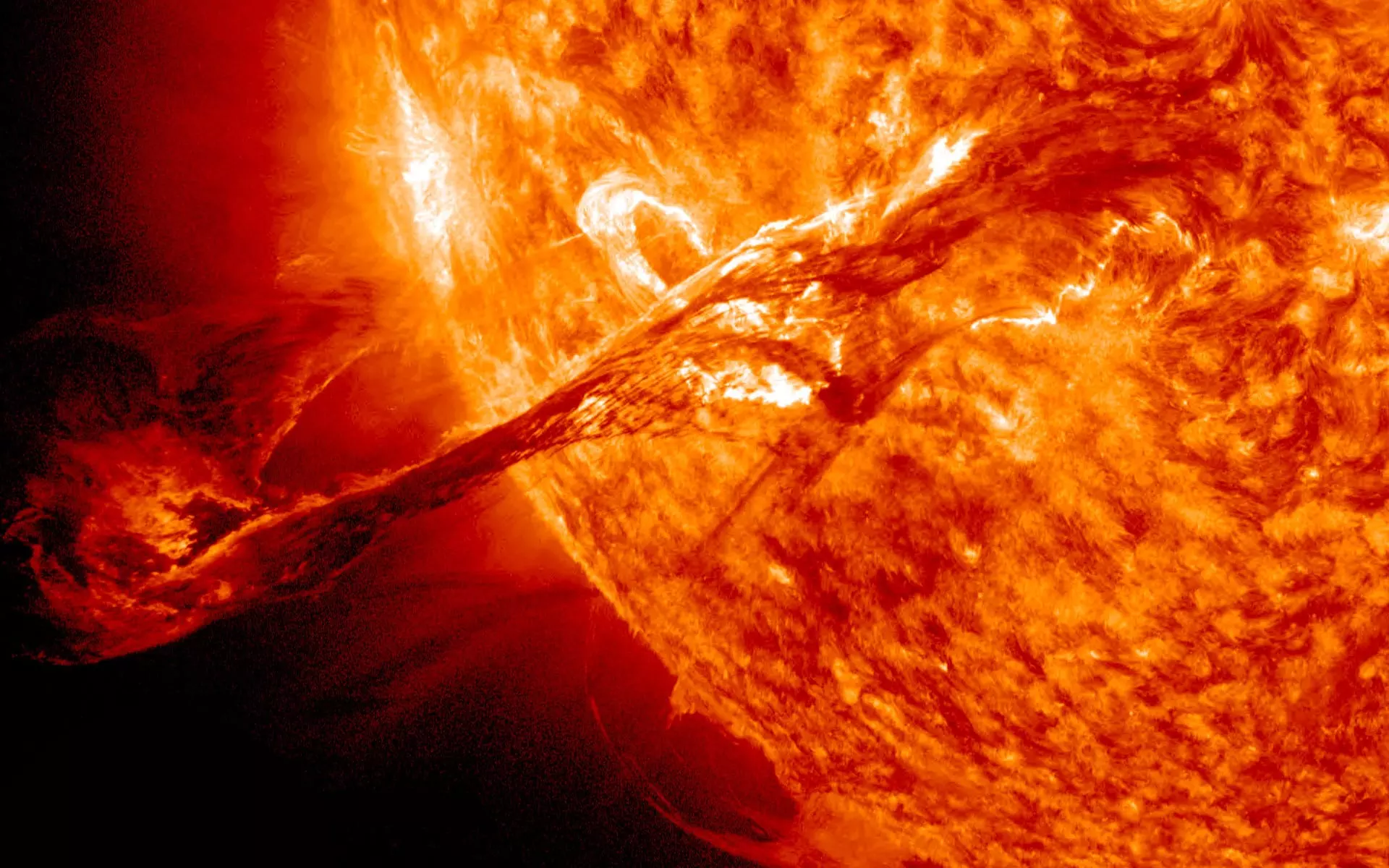

A massive solar flare with the potential of interrupting satellite communications has erupted today. Scientists at the Centre of Excellence in Space Sciences India (CESSI) said that it can affect global positioning systems (GPS) as well.
The event was predicted by the CESSI on April 18, and scientists are studying the impact of the flare. The sun is currently in the most active period called Solar Maxima of its 11-year cycle. As a result, the Sun has been spewing Coronal Mass Ejections (CMEs) frequently for the past few months. Most of them evade Earth, but some of them cause geomagnetic storms.
Solar flares are powerful bursts of energy. They can interfere with radio communications, electric power grids, and navigation signals. At times, they have posed risk to spacecraft and astronauts.
Dibyendu Nandi, Associate Professor and Coordinator of CESSI at the Indian Institute of Science Education and Research, Kolkata, said that the X2.2 class solar flare eruption took place at 3:57 UTC (9.27 IST) from the solar magnetic active region AR12992.
X-class is the most intense of flares, and the number 2.2 denotes its strength. Each letter represents a 10-fold increase in energy output, and the smallest ones are A-class, followed by B, C, M, and X.
The CESSI shared more information on Twitter saying a strong ionospheric perturbation is going on over India, South East Asia, and the Asia-Pacific regions. A high frequency of communication blackouts, satellite anomalies, GSP scintillations, and air communication impacts are expected.
The National Oceanic and Atmospheric Administration (NOAA) also said in an update the Sun is expected to be more active this week because the sunspots migrate across the visible disk. The solar flare was classified as X1.1 on April 17, and it lasted for about 34 minutes. Brief radio blackouts were reported in Southeast Asia and Australia.