













Musk calls Ambani ‘Prime Minister’, questions Reliance’s political funding
text_fields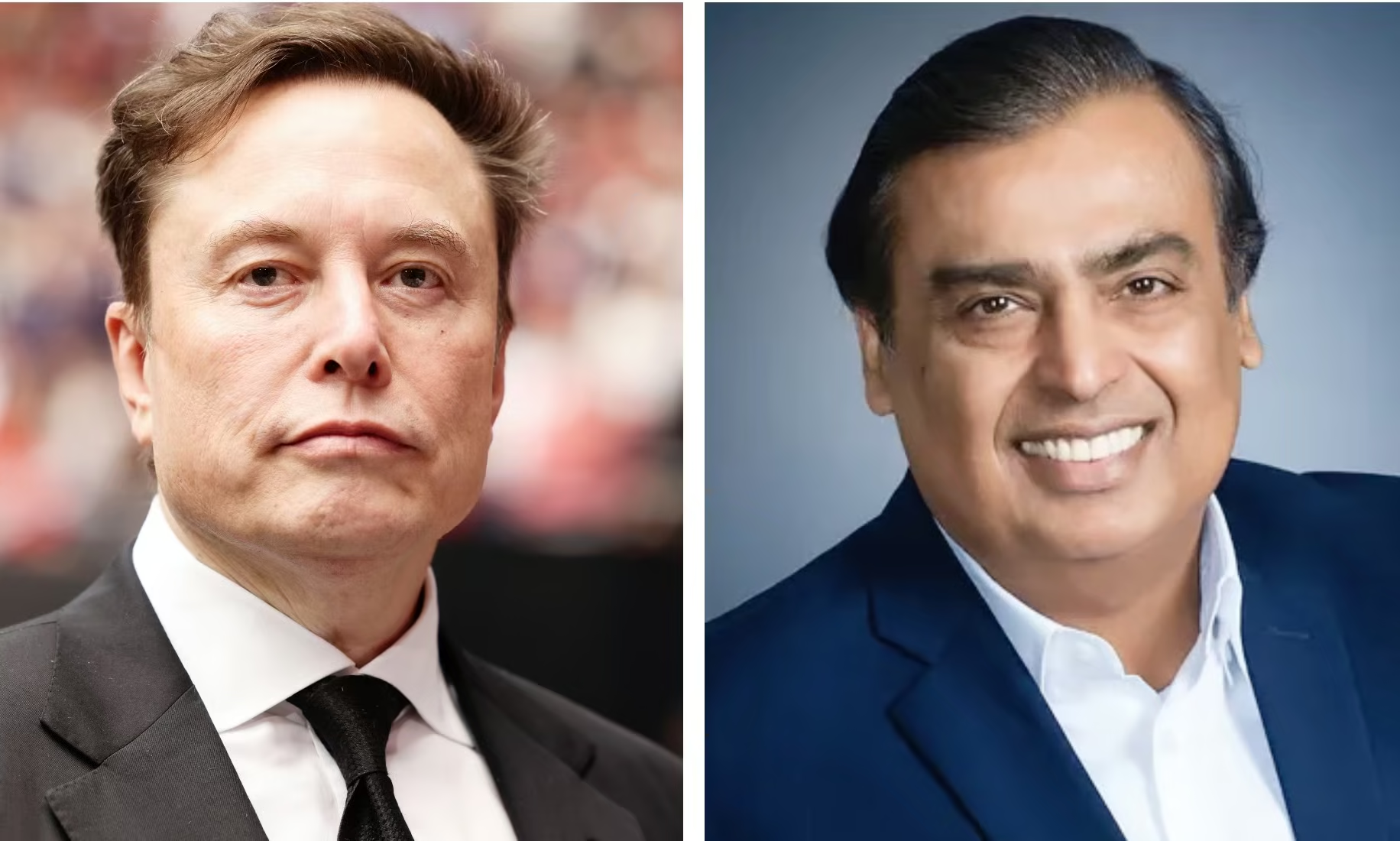

Enraged by the continued delay in securing permission to launch his Starlink satellite internet services in India, Elon Musk has intensified his attack on industrialist Mukesh Ambani, sarcastically addressing him as the “real boss of India” and “Prime Minister Ambani”, while citing media reports alleging financial links between Reliance-associated entities and the ruling BJP.
In a fresh post on X on Saturday, October 10, the billionaire entrepreneur shared screenshots of two media reports highlighting alleged connections between Reliance-linked businesses and the BJP, escalating his confrontation with Ambani amid a prolonged wait for Starlink’s entry into the Indian market.
One of the reports, published by Al Jazeera in 2022, was headlined “How a Reliance-funded firm boosts BJP’s campaigns on Facebook”, while the other, an archived Indian Express report from 2024, stated that Qwik Supply, a Reliance-linked company, had donated Rs 385 crore to the BJP and Rs 25 crore to the Shiv Sena through electoral bonds.
Musk’s latest salvo followed his earlier post in which he addressed Ambani as “Prime Minister Ambani”, accusing him of seeking to preserve a monopoly and challenging him to allow Starlink to compete in India.
“Dear Prime Minister Ambani, Please accept my humble apologies for not realising that you are the real boss of India,” Musk wrote sarcastically, adding that Ambani would naturally prefer to maintain his “monopolistic exploitation” of the Indian people, before asking whether he would nevertheless consider permitting competition.
Arguing that Starlink could transform connectivity in underserved regions, Musk said numerous areas in India lacked internet access, depriving children of educational opportunities and small businesses of the chance to sell their products in global markets. He further maintained that Starlink had proved essential in saving lives during natural disasters worldwide, particularly when conventional communication networks failed.
The Tesla and SpaceX chief has alleged that powerful business interests are obstructing Starlink’s entry to protect their dominance, claiming that certain oligarchs seek to maintain a “monopolistic chokehold” over Indian consumers. Reliance has not publicly responded to his allegations.
However, Communications Minister Jyotiraditya Scindia has rejected suggestions that India permits monopolies, asserting that the government follows a technology-neutral approach and allows consumers to choose services in a competitive market.
Scindia said three entities — Musk’s Starlink, Reliance Jio’s satellite venture Jio Satcom and Bharti-backed Eutelsat OneWeb — had secured satellite communications licences, while Amazon’s Project Kuiper had expressed interest and would have to follow the prescribed procedure.
The minister added that spectrum allocation would follow the government’s decision on the revenue-based pricing framework, while individual operators would be permitted to begin services after fulfilling security requirements and other stipulated conditions. The Telecom Regulatory Authority of India and the Department of Telecommunications were nearing a final decision on satellite spectrum pricing.
Musk, meanwhile, questioned why Starlink remained unable to launch despite being licensed in more than 165 countries, claiming that the company had spent five years complying with every Indian government requirement. The government has described allegations of selective application of its authorisation framework as “baseless and misconceived”.