

















India calls for developed nations to honour climate commitments to limit global warming
text_fields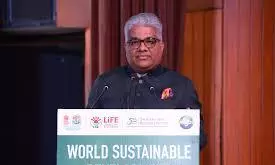

India has reaffirmed that keeping global warming within the 1.5-degree Celsius limit is still possible, but it hinges on developed countries fulfilling their financial and technological commitments.
Speaking at TERI’s World Sustainable Development Summit, Union Environment Minister Bhupender Yadav stressed that urgent reforms in global governance are needed, as the current multilateral system is failing to address climate change effectively.
Citing the 2024 UNEP Emissions Gap Report, Yadav emphasised that a 1.5-degree Celsius pathway remains technically viable through the rapid expansion of solar and wind energy, as well as afforestation efforts. However, he pointed out that achieving this goal requires immediate action and greater accountability from developed nations.
He criticised wealthy countries for failing to deliver the necessary financial support, noting that at last year’s UN climate conference in Azerbaijan, they pledged only USD 300 billion by 2035 - far below the estimated annual requirement of USD 1.3 trillion from 2025.
The minister expressed concerns over the new climate finance framework, known as the New Collective Quantified Goal, which he said shifts the financial burden from historical polluters to developing nations through voluntary contributions. This, he argued, undermines the principle of equity and allows developed nations to sidestep their obligations under Article 9 of the Paris Agreement.
Highlighting the risks of climate change, Yadav warned that if these challenges are not addressed, India could face severe economic losses, with up to 24.7 percent of its GDP at risk by 2070, according to an Asian Development Bank report.
However, he noted that India has made significant progress in sustainability, reducing its emission intensity by 36 percent between 2005 and 2020, as outlined in the country’s Fourth Biennial Update Report to the United Nations Framework Convention on Climate Change (UNFCCC). The nation aims to cut its emission intensity by 45 percent by 2030.
India’s 2025 budget prioritises long-term energy security, including plans to expand nuclear energy capacity to 100 GW by 2047. Additionally, the country has increased adaptation-related spending from 3.7 percent of its GDP in 2015-16 to 5.6 percent in 2021-22, reflecting its commitment to resilience and sustainability.
Calling for greater collaboration, Yadav urged the private sector to take a proactive role in climate action, invest in innovation, and work with research institutions to develop scalable solutions. He emphasised that incremental change is no longer enough, and all stakeholders - including corporations - must act decisively.
On the issue of adaptation finance, Yadav noted that current funding remains insufficient, despite growing global recognition of the need for nature-based and ecosystem-focused solutions. According to the 2024 UNFCCC NDC Synthesis Report, 81 percent of countries have incorporated adaptation measures into their climate strategies, particularly in areas like food security, water management, and ecosystem conservation.
Yadav concluded by stressing the importance of strengthening national climate policies with a focus on maximizing environmental, social, and economic benefits. He reiterated that strong international cooperation remains essential for meaningful climate action and urged developed nations to take responsibility for their historic emissions by providing adequate financial and technological support to developing countries.