


EC flaunts IDEA chairmanship as honour for fair elections, but what is the reality?
text_fields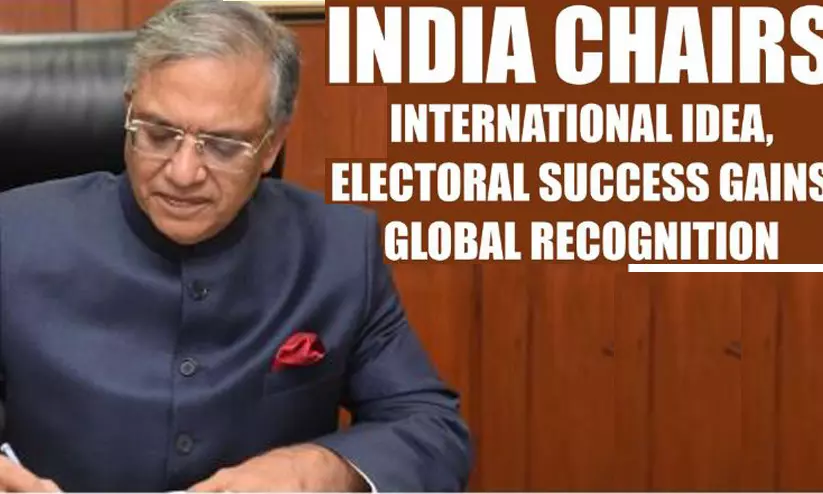

Amid the Indian Election Commission faces allegation of bias in conducting the elections and deletion of legitimate votes through the SIR process, the EC projected the chairmanship of the International Institute for Democracy and Electoral Assistance (International IDEA) as an accolade recognising the successful conduct of free, fair and transparent elections in India, however the documents show the selection as a rotational calendar function rather than a qualitative judgment of the ECI’s performance.
This flaunting is seen in the Central government’s G20 presidentialship of India as a vishwaguru – teacher to the world – and observers note that the pattern mirrors earlier attempts to convert routine responsibilities into symbolic global triumphs.
Critics warn of the collapsing distinction between an independent institution and the ruling executive, and they argue that the episode signals that the Election Commission may be aligning psychologically with the executive, according to The Wire report.
The Election Commission of India (ECI) positioned India’s assumption of the 2026 chairship of International IDEA as a moment of global appreciation, yet statutory documents and long-standing procedural norms indicate that the post follows a pre-decided regional rotation, and observers argue that the Commission has attempted to elevate a routine transition into a symbolic endorsement of its electoral stewardship.
The announcement stated that India had taken charge of the Council of Member States, and social media messaging portrayed the development as an unprecedented recognition, although records show that Switzerland held the chairship in 2025 and India was scheduled to follow as part of an established calendar.
This gap between institutional fact and public portrayal has drawn scrutiny, and analysts suggest that the framing resembles the approach used during India’s G20 presidency, when a rotational responsibility was rebranded as a diplomatic triumph intended to cultivate domestic prestige.
The comparison has led commentators to caution that such political communication risks blurring the institutional separation between the ECI and the ruling establishment, and the concern is amplified by recent debates surrounding the Commission’s handling of poll dates, Model Code of Conduct enforcement and electoral bond disclosures.
The domestic context sharpens these anxieties, as former Election Commissioners have raised alarms about the ongoing Special Intensive Revision (SIR) of electoral rolls, which began in Bihar and has gradually expanded across the country, and they argue that the process has shifted the onus of proof onto voters while leaving unresolved questions about potential exclusions.