










BJP leader warns of Mira Road-like violence if 'Madrasas and Mosques' are not razed
text_fields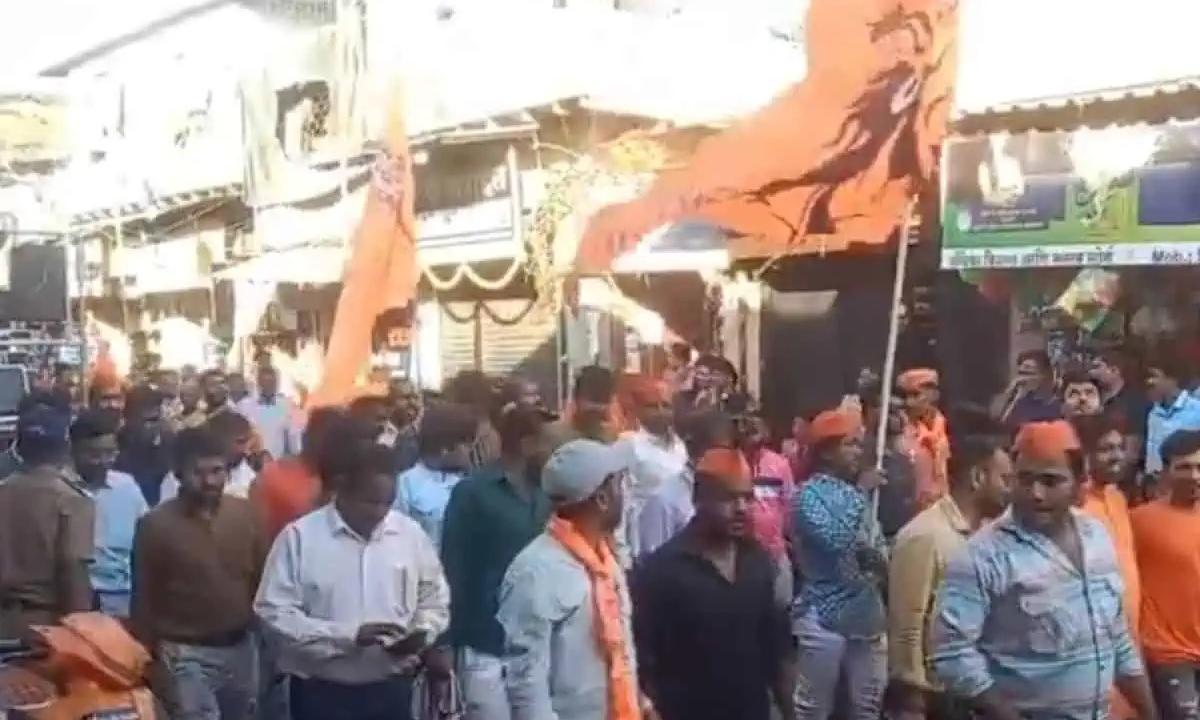

The anti-Muslim rally held by BJP leader Nitish Rane in collaboration with the Sakal Hindu Samaj on February 14 demanded that the authorities demolish what they termed 'illegal madrasas and mosques’ in Maharashtra’s Shivaji Nagar.
Participants, adorned in saffron turbans and brandishing anti-Muslim placards, paraded through the streets chanting slogans against 'Love Jihad' and urging Hindu women to reject traditional attire.
'Love Jihad,' a conspiracy theory propagated by far-right groups, alleges that Muslim men engage in deceitful practices to convert Hindu women to Islam through marriage.
Rane, known for his incendiary rhetoric, reiterated these sentiments at the rally, calling for immediate action against alleged encroachments by mosques and madrasas in Shivaji Nagar. He warned of potential communal violence akin to recent clashes in Mira Road, Thane district if action wasn't taken promptly.
The Mira Road incident, which occurred on January 21st, witnessed clashes between Hindus and Muslims following a provocative procession by Hindutva supporters ahead of the Ram Mandir inauguration in Ayodhya. This procession, characterized by saffron flags and chants of 'Jai Shri Ram,' ignited tensions in a minority-dominated area, leading to subsequent confrontations.
In response, the district administration ordered the demolition of alleged illegal encroachments, primarily belonging to the Muslim community, on January 23rd.
The operation, accompanied by police and security personnel, resulted in the demolition of multiple structures, as captured in viral social media videos. Despite claims of assault and arson lodged by Muslims, no Hindutva supporters were arrested in connection with the clashes, prompting criticism of biased law enforcement.
The aftermath of these events has left the community on edge, with concerns over escalating communal tensions and the targeting of minority establishments. Rane's inflammatory rhetoric and the perceived inaction of authorities have fuelled apprehensions among minority groups, who fear further marginalization and discrimination.
As voices on both sides of the political spectrum weigh in on the situation, the government's response and future actions regarding alleged encroachments and communal tensions remain under scrutiny.
With elections looming on the horizon, the issue is likely to remain a focal point of debate and contention, underscoring the complex interplay of religion, politics, and communal relations in contemporary India.