















World Health Assembly 2025 to finalise pandemic treaty, address budget shortfall amid U.S. funding cuts
text_fields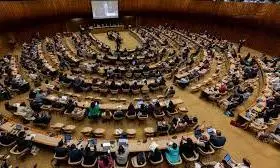

The World Health Organization (WHO) is set to host a pivotal annual assembly in Geneva from May 19 to 27, where global health leaders will gather to adopt a groundbreaking pandemic preparedness agreement.
The event intends to tackle deep financial challenges triggered by reduced funding from the United States.
Over 190 member states will participate in the World Health Assembly (WHA), the organisation’s top decision-making body. This year’s session comes at a critical juncture for global health, with mounting challenges including new threats and shifting priorities in international health and development.
A major focus will be the anticipated approval of a new international accord aimed at strengthening the global response to future pandemics. This follows more than three years of intense negotiations spurred by the devastating impact of COVID-19. While a consensus was reached last month on the text of the agreement, formal adoption by the WHA is expected to take place on Tuesday.
“This gathering marks a significant moment for public health cooperation,” said Catharina Boehme, WHO’s assistant director-general for external relations and governance.
Notably absent from the final stages of negotiation was the United States, which has recently slashed its foreign aid budget and distanced itself from the WHO. U.S. President Donald Trump had previously ordered a withdrawal from the organisation and pandemic accord discussions.
Despite this, the agreement is being hailed as a win for international collaboration.
Central to the agreement is the Pathogen Access and Benefit-Sharing System (PABS), which aims to ensure rapid sharing of pathogen data with pharmaceutical companies to speed up the development of vaccines and treatments. While the agreement may be adopted next week, technical negotiations on the PABS system will continue, with full implementation expected by 2026.
The treaty will officially come into force once it has been ratified by at least 60 countries.
Beyond the treaty, WHO will also face pressing financial matters. The agency is preparing to operate with a significantly reduced budget after the U.S. — its largest donor — signaled plans for a complete withdrawal by January. The U.S. had contributed $1.3 billion to WHO’s 2022–2023 budget, largely through earmarked donations.
As part of the belt-tightening, Tedros announced a sharp reduction in the agency’s leadership team.
To address funding instability, member states will vote on a proposed 20% increase in mandatory membership fees for the 2026–2027 period — part of a previously agreed strategy to have such fees cover 50% of WHO's overall budget.
Without this increase, WHO would be facing an even more severe deficit. “Our current financial situation would be $300 million worse without that earlier decision,” Tedros explained.
The agency has proposed a trimmed-down budget of $4.2 billion for 2026–2027, reflecting a 21% cut from the initial $5.3 billion plan. If the membership fee hike is approved, WHO expects to raise over $2.6 billion — more than 60% of its required budget. However, that still leaves a shortfall of $1.7 billion.