









Iran threatens blocking Gulf countries' oil exports if US embargo hits
text_fields
DUBAI (Reuters) - Iran’s Supreme Leader Ayatollah Ali Khamenei has endorsed President Hassan Rouhani’s warning that Iran may block Gulf oil exports if its own exports are stopped, Reuters reported. The Supreme Leader added that negotiations with the United States would be an “obvious mistake”.
Rouhani’s apparent threat earlier this month to intercept oil shipments from neighboring countries, mainly the Gulf countries, came in response to imminent U.S. sanctions and efforts by Washington to force all countries to stop buying Iranian oil.
“(Khamenei) said remarks by the president ... that ‘if Iran’s oil is not exported, no regional country’s oil will be exported,’ were important remarks that reflect the policy and the approach of (Iran’s) system,” Khamenei’s official website said.
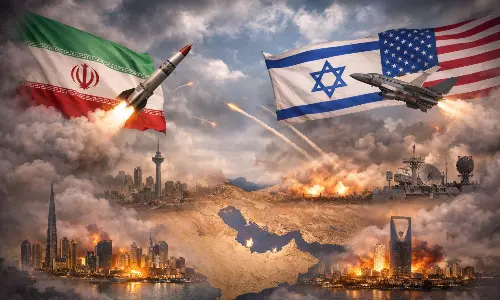
Iranian officials have in the past threatened to block the Strait of Hormuz, a major oil shipping route, in retaliation for any hostile U.S. action. The Strait lies between the Persian Gulf and the Gulf of Oman, and is the only passage for the Gulf's oil to the open seas, and therefore critical for oil exports from the Gulf countries. About 20% of the world's crude oil is estimated to flow throw the Hormuz.
Khamenei made his statement during a speech to foreign ministry officials on Saturday to rule out any renewed talks with the United States after President Donald Trump’s decision to withdraw from a 2015 international deal over Iran’s nuclear program.
“The word and even the signature of the Americans cannot be relied upon, so negotiations with America are of no avail,” Khamenei said.
It would be an “obvious mistake” to negotiate with the United States as Washington was unreliable, Khamenei added, according to his website.
The endorsement by Khamenei, who has the last word on all major issues of state, is likely to discourage any open opposition to Rouhani’s apparent threat.
Khamenei also voiced support for continued talks with Iran’s European partners in the nuclear deal which are preparing a package of economic measures to offset the U.S. pullout from the accord.
“Negotiations with the Europeans should not be stopped, but we should not be just waiting for the European package, but instead we should follow up on necessary activities inside the country (against U.S. sanctions),” Khamenei said.
However, not all Europe looks inclined to make an embargo-free deal with Iran. France said earlier this month that it was unlikely European powers would be able to put together an economic package for Iran that would salvage its nuclear deal before November. Iran’s oil exports could fall by as much as two-thirds by the end of the year because of new U.S. sanctions, putting oil markets under huge strain amid supply outages elsewhere in the world.
Washington initially planned to totally shut Iran out of global oil markets after Trump abandoned the deal that limited Iran’s nuclear ambitions, demanding all other countries to stop buying its crude by November.
But it has since somewhat softened its positionto the effect that it may grant sanction waivers to some allies that are particularly reliant on Iranian supplies.