










VP Dhankhar slams BBC: Cannot ‘run down’ SC and its judgement as ‘irrelevant’
text_fields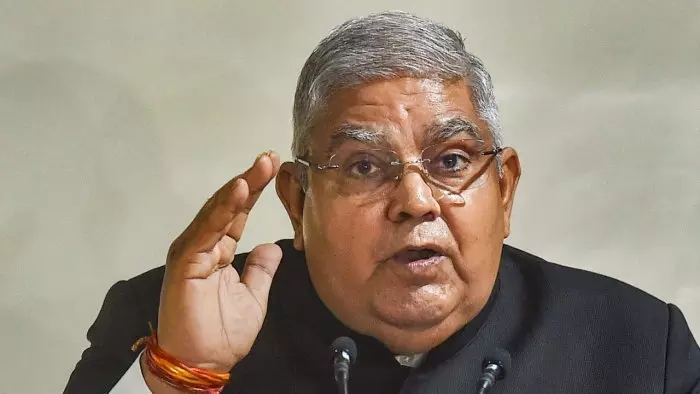

Vice President Jagdeep Dhankhar has slammed the British Broadcasting Corporation (BBC) for its documentary on Prime Minister Narendra Modi saying that the Supreme Court’s judgement in the matter cannot be treated as ‘irrelevant’.
He said that one cannot ‘run down’ the apex court and its 20-year ‘thorough investigation’ to ‘play politics the other way around’ expecting the citizens of the country to ‘keep quiet’.
Dhankar was speaking during the virtual inaugural event of the Bengaluru Indian Institute of Management’s (IIM) Management Development Centre block on their new campus.
“An investigation controlled by the highest court of the land, and mark my words, now that 20-year investigation at all levels — trial court, High Court, SIT, Supreme Court as it culminated into a judgment of the Supreme Court in 2022. And we have a documentary they did not think was relevant for 20 years? No, 20 years wasn’t relevant to them, after the highest court of the land, an independent court mechanism of the country came to a firm conclusion in 2022. You plan to play politics the other way around and you want a citizen of this country believing in nationalism to keep quiet?” he said.
 Also Read:BBC Documentary: Why there was no high-voltage reaction for the second part?
“So, in the name of expression can you run down by the Supreme Court, can you run down two decades of thorough investigation? This is playing politics the other way around. When people choose to play politics the other way around, the young minds here and outside are intellectually equipped to challenge them,” he said.
Hitting out at the public service broadcaster, the VP said that they chose to engage in some kind of flouting of narratives” and warned the nation to be cautious against a ‘sinister kind of politics’ which according to him was practiced within and outside India to tarnish its governance, democratic polity, and institutions.
“Can I allow anyone under that guard to make any statement about you, about your institute, about an individual, about an industry unverified and uncorroborated? Being part of a campaign or otherwise, setting a flouted narrative? No. This immunity comes with a great responsibility and a deep sense of accountability. I cannot allow Rajya Sabha to be an akhada of free fall of information, making allegations against anyone. You’re entitled to make any statement but authenticate it, be responsible about it,” the Vice President pointed out.
The BBC documentary India: The Modi Question, a two-part series, chronicles the events that transpired during the 2002 Godhra riots in Gujarat when Narendra Modi was the Chief Minister of the state.

It looks at the trajectory of Modi’s rise to power and the consequent rising tensions between the prime Minister and the Muslim minority community in the country.
The documentary accuses Modi of targeting and discriminating against the country’s 200 million Muslims by enforcing the right-wing Hindutva agenda.
It also included a ‘previously unseen and confidential UK government report produced after the riots that found Modi responsible for the violence and described the riots as having the “hallmarks of ethnic cleansing”, as reported by The Guardian.
The documentary also included an interview with Jack Straw, UK foreign secretary at the time who accused Modi of ‘tacitly encouraging the Hindu extremists,” and preventing the police from doing their job during the riots.
The Indian government was quick to slam the documentary calling it a ‘propaganda piece' and accusing BBC of its ‘colonial mindset’.
Just a few weeks after the release of the documentary, BBC offices in Delhi and Mumbai were raided by Income Tax officials with documents and phones confiscated and offices sealed.
