













Madras HC rules public land can’t be reserved for one religious community
text_fields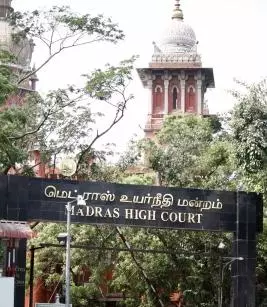

The Madras High Court’s Madurai Bench ruled that government-owned public land cannot be set aside exclusively for a single religious community.
The court permitted a group of Hindus to hold Annadhanam (a community meal) during the Kumbabisekam ceremony of the Kaliyamman Temple on the same public ground in Dindigul district that Christians traditionally use for Easter celebrations.
Justice G.R. Swaminathan delivered the order on October 31, 2025, while hearing a petition filed by K. Rajamani, a resident of N. Panchampatti village. Rajamani had requested permission to organise the event on November 3 in connection with the temple festival. His earlier application was rejected by the Athur Taluk Tahsildar on October 24, who had instead directed him to use a nearby public road, the N. Panchampatti to Munnilaikottai stretch, as an alternative location.
The petitioner contested the Tahsildar’s order, arguing that the open land in Survey No. 202/3, known locally as Sunkasavadi Ground and situated near the Kaliyamman Temple, was a government-owned village common area, Law Beat reported.
During the hearing, the Inspector of Police from Chinnalapatti personally appeared and opposed granting permission for the event, citing potential law and order concerns.
Meanwhile, the counsel representing the fourth respondent, Suresh Perkmans, on behalf of the Christian community, claimed that part of the ground included a century-old structure called the Pascha Stage, traditionally used for Easter programmes and religious dramas.
He contended that Hindus had never been permitted to use the site for religious purposes and pointed to Tahsildar records from 1912 and a 2017 peace committee resolution, both stating that only customary events held for the last 100 years were allowed.
However, the court observed that both the fourth respondent’s counter affidavit and the submissions made by the Special Government Pleader confirmed that the land in question was classified as “vacant site/grama natham” and thus was government property, not owned by any religious group.
Justice G.R. Swaminathan ruled that a public ground owned by the government cannot be reserved for a single religious community, emphasising that such land must remain accessible to everyone regardless of faith or community.
Rejecting the argument that only the Christian community could use the site because of long-standing practice, the judge clarified that their traditional use of the ground for Easter could continue without disruption, but that did not justify denying Hindus permission to conduct Annadhanam on a different day.
The court stated that excluding any group purely on religious grounds would violate Article 15 of the Constitution. It also cited previous rulings that recognised Annadhanam as a religious act protected under Article 25, describing it as “a means to seek salvation (Moksham) and therefore an observance of religious significance.”
The judge further noted that authorities cannot restrict fundamental rights on the basis of anticipated law and order concerns. Referring to police submissions, the court mentioned that N. Panchampatti village has roughly 2,500 Christian families and 400 Hindu families, and that the denial of permission had been justified by the police on this demographic imbalance.
Setting aside the Tahsildar’s order of October 24, 2025, the court allowed the petitioner to conduct Annadhanam on November 3, 2025, at the disputed ground, directing that the site be restored to its original state afterwards. It also instructed the Superintendent of Police, Dindigul, to ensure the event proceeded peacefully.
The writ petition was allowed, with no order as to costs.