












Delhi pollution control panel submits Yamuna Cleanup Plan to PMO
text_fields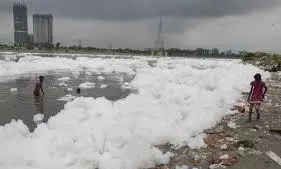

New Delhi: With a new government taking charge in Delhi, the Delhi Pollution Control Committee (DPCC) has submitted a comprehensive plan to the Prime Minister’s Office (PMO) for the rejuvenation and cleanup of the Yamuna River.
The proposal, submitted last week, highlights key measures such as enhancing sewage treatment capacity, trapping major drains, and beautifying the riverfront, officials confirmed on Wednesday.
The Yamuna’s deteriorating condition was a central issue during the recent Delhi Assembly elections, with the BJP criticising the previous AAP government for failing to restore the river over the past 10 years. After securing 48 out of 70 seats, the BJP has pledged to prioritise the river’s cleanup.
According to the DPCC’s report, a 48-km stretch of the Yamuna from Palla to Asgarpur village has been categorized as a "Priority-1" (top priority) polluted zone. A major concern is the high Biochemical Oxygen Demand (BOD) levels, which far exceed the recommended standard of 3 mg/l. The plan emphasises the need for a minimum environmental flow (E-flow) of 23 cumecs (437 MGD) to improve water quality, but Delhi currently struggles with water shortages. Pending dam projects such as Renuka, Lakhawar, and Kishau could help address this issue.
To curb pollution, the Delhi government has committed to a 100% sewage treatment initiative, which includes upgrading 37 existing Sewage Treatment Plants (STPs) and constructing new ones; increasing sewage treatment capacity from 792 MGD in 2023 to 964.5 MGD by December 2026; setting up a new STP at Delhi Gate and 40 decentralized STPs (DSTPs); and upgrading 14 existing STPs by December 2026.
Efforts are also being made to trap and divert 22 drains that pollute the Yamuna. So far, 10 drains have been tapped, 2 are partially tapped, and 8 remain untreated. Five major drains - Najafgarh, Shahdara, Barapullah, Maharani Bagh, and Mori Gate - are set to be addressed, aiming to divert 48.14 MGD of wastewater by December 2025.
The sewerage network is being extended to unauthorised colonies and JJ clusters, with work ongoing in 1,799 colonies, and a target completion date of December 2026.
Encroachments along the Yamuna floodplain are also being tackled. Over the past 31 months, more than 1,500 acres have been cleared, with drone surveys helping identify further areas for removal. The Delhi Development Authority (DDA) has been assigned the task of riverfront restoration, biodiversity park development, and debris removal.
The plan also includes initiatives for the beautification and ecological restoration of the Yamuna riverfront including the development of 11 biodiversity parks and wetlands, covering 1,600 hectares; restoration of historical ghats, with Vasudev Ghat already developed and further conservation efforts underway; and removal of construction debris left from bridge, metro, and rail projects.