
















Delhi doctors remove 1.16-kg hairball from 20-year-old who ate hair for 11 years
text_fields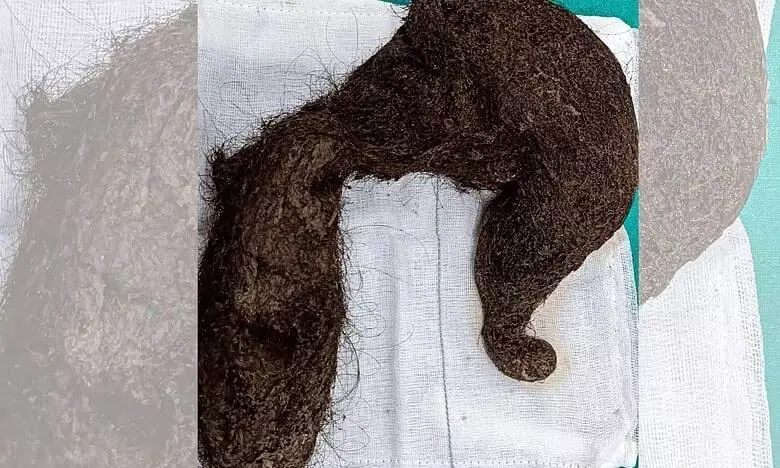

New Delhi: A 20-year-old student underwent surgery at a private hospital in Dwarka after doctors removed a 1.16-kg hairball from her stomach, formed over 11 years of repeatedly swallowing her own hair.
The woman, who has been diagnosed with trichophagia, began consuming strands of hair when she was about nine. She was admitted to Manipal Hospital after three days of severe abdominal pain, nausea and repeated vomiting, alongside a longer history of poor appetite, weight loss and fatigue.
Clinical examination revealed a hard mass in the upper abdomen. Further tests, including an upper gastrointestinal endoscopy, identified a large trichobezoar — a compacted ball of indigestible hair — occupying most of the stomach cavity.
According to the treating team, the hairball had assumed a J-shape and stretched from the junction of the oesophagus and stomach to the beginning of the small intestine. Its size and density caused marked gastric distension, leaving minimal room for safe manipulation during removal.
Initial attempts to break up and extract the mass endoscopically proved unsuccessful. The surgeons then shifted to a laparoscopic approach, making a small incision in the abdomen to free the bezoar from the stomach lining and remove it intact. The extracted mass weighed 1.16 kg.
Dr Sandeep Aggarwal, Chairman of the Institute of Minimal Access, Bariatric, GI and Robotic Surgery at the hospital, said the stomach was “completely packed” with the trichobezoar, complicating the procedure and raising the risk of injury to the gastric wall.
Post-surgery, the patient’s abdominal symptoms subsided. Her appetite improved, she began tolerating food, gained weight and has since returned to her studies.
Doctors noted that trichobezoars often go undetected for years, as individuals may not view hair-eating as a medical issue or may not disclose it during consultations. They advised that persistent abdominal complaints, unexplained weight loss and a palpable abdominal lump should raise suspicion of a bezoar, especially where there is a known history of trichophagia.
While surgical removal addresses the physical complication, it does not treat the underlying behavioural disorder. The medical team emphasised the need for early identification of trichophagia and sustained psychological support to prevent recurrence.