
















Tagged amur falcons fly 5,000 km from Manipur to Africa, leaving scientists amazed
text_fields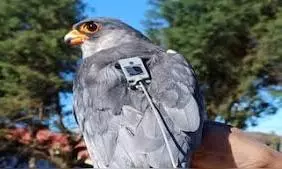

Two Amur falcons from Manipur have amazed researchers by completing a 5,000–6,000 km migration from India to Africa in less than a week.
The birds, Apapang and Alang, weigh only 150 grams.
Their journey is part of Phase 2 of the Manipur Amur Falcon Tracking Project. A third bird, Ahu, was also tagged.
All three birds were fitted with satellite tags on November 11 at Chiuluan in Tamenglong district. The tagging was carried out by the Manipur Forest Department and the Wildlife Institute of India. Their real-time movements were posted daily on social media by senior forest officer Supriya Sahu, turning the migration into a widely followed story.
Apapang, an adult male, began a rapid flight soon after tagging. By November 14, he had crossed central India and reached the Arabian Sea. He was ready for the difficult 3,000 km journey over water to Somalia.
Alang, a young female, and Ahu, an adult female, followed the same route.
On November 16, all three falcons were tracked above the Arabian Sea. Strong easterly tailwinds supported their non-stop flights. Apapang flew without a break for about 76 hours. He covered around 3,100 km at nearly 1,000 km per day. This pushed the limits of what a small raptor is known to endure.
"Woohoo .. both Apapang and Alang have successfully crossed over, while Ahu is just about to reach...three Amurs, one breathtaking migration and a million people watching in awe," Sahu posted on X.
Suresh Kumar from the Wildlife Institute of India told Sahu that Amur Falcons are land birds that cannot stop on water. Once they leave the Indian coast, they fly continuously across the Arabian Sea. The flight covers almost 3,000 km.
By November 17, Apapang had reached Somalia in the Horn of Africa. He had travelled about 5,400 km in 5 days and 15 hours. On November 18, Sahu confirmed that both Apapang and Alang had crossed successfully. Ahu was close to the African shoreline. Birdwatchers closely following the updates reacted with excitement.
By November 20, project scientist Suresh Kumar said that Apapang and Alang had crossed into Kenya. They were likely heading toward Tsavo National Park. Ahu remained near Somalia’s northern tip. Updated data showed Apapang covering about 6,100 km in 6 days and 8 hours. Alang flew around 5,600 km in 6 days and 14 hours, with short stops in Telangana and Maharashtra. Ahu travelled about 5,100 km after pausing briefly in Bangladesh before joining the ocean crossing.