






Rare aurora display to be visible from India as solar storm approaches Earth
text_fields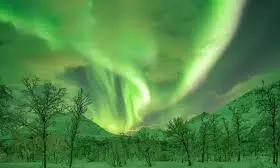

A powerful solar storm is expected to reach Earth on June 9, creating conditions for rare aurora displays that could be visible from parts of northern India, particularly the Ladakh region.
The event was triggered by a solar eruption on June 6 that sent a massive cloud of magnetised plasma toward Earth at a speed of about 1,400 kilometres per second. The US Space Weather Prediction Center has issued a G3, or strong, geomagnetic storm watch, with brief periods of G4, or severe, conditions possible.
The storm is expected to peak between 11:30 pm IST and 2:30 am IST on June 9.
Auroras occur when charged particles from the Sun interact with gases in Earth's upper atmosphere, producing colourful displays of green, red, and purple light.
According to astronomers, Hanle village in Ladakh offers the best chance of witnessing the phenomenon in India. Located about 4,500 metres above sea level, Hanle sits near the edge of the auroral zone that can expand during major geomagnetic storms.
Scientists previously recorded an aurora over Hanle in January this year using all-sky cameras at the Indian Astronomical Observatory.
Other high-altitude areas such as the Nubra Valley, Pangong Tso, parts of Kashmir, and the higher Himalayan regions of Uttarakhand may also have a chance of seeing a faint glow on the northern horizon, though visibility is expected to be less certain.
Experts say major Indian cities such as Delhi, Mumbai, Bengaluru, Kolkata, Chennai, and Hyderabad are unlikely to offer suitable viewing conditions due to light pollution or monsoon cloud cover.
Internationally, stronger displays are expected across Scotland, Scandinavia, Iceland, northern Germany, Poland, Canada, and parts of the northern United States. In the Southern Hemisphere, visibility may extend to Tasmania, New Zealand's South Island, and southern regions of Argentina and Chile.
Observers in Ladakh are advised to look north after midnight from a dark location, allow their eyes time to adjust to the darkness, and use long-exposure photography to improve the chances of capturing the phenomenon.