










Deported as illegal migrants, 4 Bengalis return to India after a year
text_fields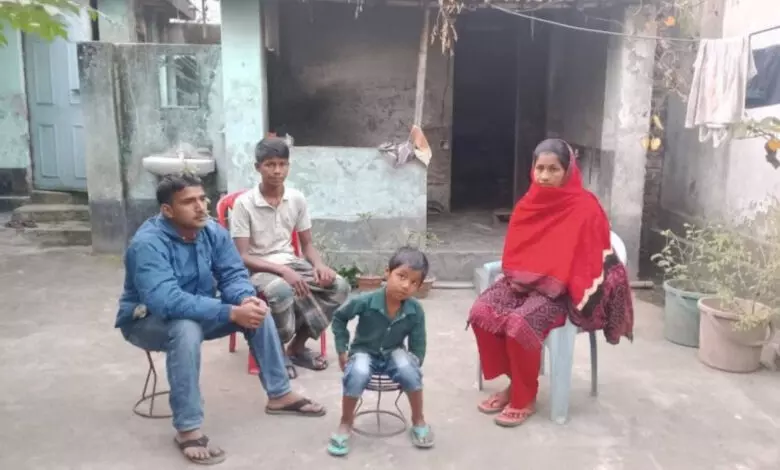

Kolkata: Six West Bengal natives, including three minors and two women, were picked up in Delhi in June 2025 as suspected illegal migrants, taken to Assam and allegedly pushed across the border into Bangladesh. Four of them returned to India in July 2026 after spending nearly a year in Bangladesh, where they had been arrested as illegal Indian immigrants.
“Isn’t it absurd that someone can just be picked up and thrown out of the country purely on a whim?” Sweety Bibi, 33, told Article 14. “I still can’t believe this really happened.”
Sweety and her sons, aged 17 and seven, along with Danish Sekh, returned to India on July 8 this year. Danish’s wife, Sunali, and their eight-year-old son, who were deported with them, had been allowed to return six months earlier, in December 2025.
Danish and Sunali lived with their son Sabir in a shanty in Bangali Basti in Delhi’s Rohini. On June 18, 2025, police arrived in the slum searching for undocumented Bangladeshi migrants and picked up Danish along with several others.
Sweety and her two sons, Kurban and Imran, were picked up from a neighbouring shanty. Sunali and her son were detained when she went to the police station to inquire about her husband.
The six were subsequently produced before the Foreigners Regional Registration Office (FRRO) in RK Puram. On June 26, 2025, the FRRO issued deportation orders against all six.
They were allegedly taken to Assam and pushed into Bangladesh, while their families remained unaware that they had been deported.
None of the six could recall exactly when or where they were left after being taken out of a police vehicle. Sunali, who grew up in forested areas of Birbhum in West Bengal, said the darkness was unlike anything she had experienced before.
Danish, Sunali, Sabir, Sweety, Kurban and Imran said they did not know where they had been left. According to Danish, Border Security Force (BSF) personnel ordered them to run into the woods.
When they refused, the BSF personnel allegedly told them, “Run, or get shot,” Danish said.
The group ran into the forest without food, money or identification documents, which they said had been taken from them before the deportation.
Sunali told Article 14 that they spent their first night at the edge of the forest, afraid to venture further into the darkness. After sunrise, they set out in search of a village.
Several days passed before they realised they were repeatedly moving through the same area.
“We were circling the same areas,” Danish said.
It was only after they reached a village six or seven days later that they realised they were in Bangladesh. They had been pushed across the border from Assam.
Villagers provided them with food and water, while a panchayat member informed the Border Guard Bangladesh (BGB).
The BGB then instructed the six to try crossing back into India through another forested stretch. They were allegedly told to keep running and not stop even if Indian border security personnel ordered them to halt.
The group ran through muddy, forested terrain, repeatedly falling and getting back up. At one point, BSF personnel heard them moving and shouted, “Halt.”
The group continued running. Moments later, armed BSF personnel appeared in front of them with their guns pointed at them. Danish alleged that the personnel beat them “black and blue” before forcing them back into Bangladesh.
After being advised to look for work in Dhaka, the group spent a week in the capital doing odd jobs. They later moved to Chapainawabganj, a district bordering West Bengal, hoping to find a way back into India.
In Alinagar village in Chapainawabganj, police traced the group and arrested all six on charges of being illegal Indian immigrants.

The Calcutta High Court subsequently ordered the Union government to bring the six Indians back to India and termed their detention and deportation illegal.
The Centre challenged the order in the Supreme Court but agreed to bring Sunali and her minor son back on “humanitarian grounds” after the court was informed that she was in an advanced stage of pregnancy.
The government later said, on May 22, 2026, that it would bring Danish, Sweety and her two sons back to India for verification of their citizenship, citing the “peculiar facts and circumstances of the case”. The Centre maintained that the decision should not be treated as a precedent.
The families also sought assistance in Bangladesh, while TMC MP Samirul Islam helped coordinate their bail proceedings there.
Faruk Ali, a West Bengal native who had settled in Bangladesh in 1993, agreed to stand surety for their bail as a Bangladeshi citizen. The six were released on December 1, 2025.
After Sunali and Sabir returned to India that month, the remaining four moved into Ali’s home and waited to return.
“The neighbours were truly helpful,” Sweety said, recalling her time at Ali’s house. “They checked on us if we needed anything. They gave us rice and vegetables on several occasions.”
She said the family remained grateful for the support, adding that they could not have fought the legal battle alone.
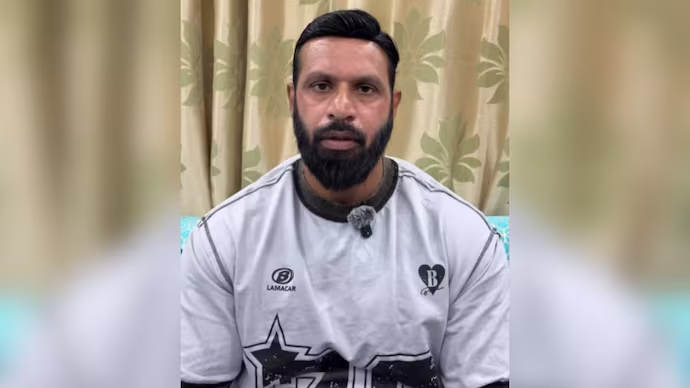
Although Sunali, Danish and Sweety have returned to India following court orders, their citizenship remains under scrutiny.
In December last year, Supreme Court Justice Joymalya Bagchi said Sunali only needed to establish that her father was Bhodu Sekh to prove her citizenship.
The names of Bhodu Sekh and Jyotsna Bibi, Sunali’s parents, appeared in the 2002 electoral rolls in West Bengal’s Murarai Assembly constituency. Their names were retained in the 2025-26 electoral rolls following the Special Intensive Revision (SIR) in West Bengal.
Sunali’s Aadhaar card also identifies Bhodu Sekh as her father. However, she does not have a birth certificate.
Her name can no longer be found in the Delhi electoral rolls, with her family claiming that it was deleted. Sweety’s name was similarly removed from the electoral rolls following the SIR in the capital.
Danish also does not have a birth certificate, although his family possesses land records dating back to the 1970s. He also has an Aadhaar card and a school-leaving certificate.
Whether these documents will be sufficient to establish their citizenship remains uncertain, particularly amid a growing number of cases involving Bengali-speaking Muslims facing citizenship challenges despite possessing identification documents.