















Hamas accuses Israel of ‘organised terrorism’ at Rafah crossing
text_fields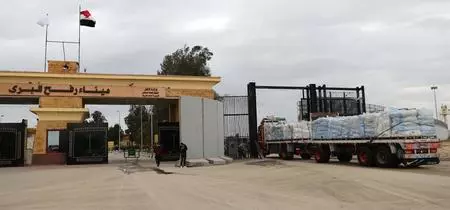

Hamas on Tuesday alleged that Palestinians attempting to return to Gaza through the Rafah crossing were being subjected to mistreatment, abuse and deliberate extortion, describing the practices as amounting to collective punishment and characterising them as organised and coercive in nature.
In a statement, the group said accounts from the ground pointed to humiliating treatment of travellers, including the alleged detention of women, blindfolding, prolonged questioning on what it called irrelevant matters, threats involving their children and attempts to coerce at least one woman into collaboration.
Hamas claimed these actions showed that what was taking place went far beyond routine border procedures and instead reflected systematic violations intended to intimidate people and discourage them from returning to their homes, Maktoob Media reported.
The group called on international human rights organisations to record and investigate the alleged abuses.
Reports said around 135 Palestinians had reached the Rafah crossing in the hope of travelling abroad for urgent medical treatment, though it remained uncertain how many would ultimately be permitted by Israel to enter Egypt. On the first day of the crossing’s partial reopening on Monday, after nearly two years of closure, only five critically ill Palestinian patients were allowed to leave Gaza.
International Committee of the Red Cross spokesperson Pat Griffiths was quoted as saying that the lack of clarity surrounding the reopening of the Rafah crossing was deepening the suffering of Palestinians in Gaza, many of whom had endured extreme trauma. He added that people he had spoken to during recent visits expressed a strong desire for a return to normal life, while recognising that recovery would take considerable time.
Al Jazeera correspondent Hind Khoudary, reporting from Khan Younis in southern Gaza, said there was still no clear explanation for delays at the crossing. She reported that new procedures were being used to tightly control movement through Rafah, resulting in lengthy processing times. According to her account, only five patients were allowed to leave Gaza on the first day, followed by 16 the next day, while just 12 Palestinians were permitted to return to the enclave. She added that families were waiting anxiously for relatives after years of separation, with dozens of others still unaccounted for amid ongoing searches.
Khoudary also said that strict limits were being imposed on travellers, including restrictions on carrying personal belongings. She noted that around 20,000 people in Gaza were in need of urgent medical care abroad, while the number of people allowed to leave the territory each day remained extremely small in comparison.
Palestinian Authority won’t be part of post-war Gaza governance: Netanyahu to US envoy
Jerusalem: Israeli Prime Minister Benjamin Netanyahu told US envoy Steve Witkoff during a meeting in Jerusalem on Tuesday that the Ramallah-based Palestinian Authority would have no role in governing Gaza after the war.
According to a statement issued by Netanyahu’s office following the talks, the prime minister made it clear that the Palestinian Authority would not be involved in administering the Gaza Strip in any capacity. The statement came amid continuing uncertainty over Gaza’s post-war governance under US President Donald Trump’s ceasefire plan, which brought an end to a two-year conflict in the territory but did not clearly define the Palestinian Authority’s future role.
In the interim, a technocratic body, the National Committee for the Administration of Gaza, has been set up to manage day-to-day affairs until the Palestinian Authority completes an internal reform process.
Witkoff’s discussions with Netanyahu took place shortly after the reopening of Gaza’s Rafah crossing with Egypt and marked their second meeting in under two weeks. During the talks, Netanyahu also reiterated Israel’s position that Hamas must be disarmed, Gaza demilitarised and Israel’s stated war objectives achieved before any reconstruction of the territory could begin, his office said, AFP reported.
Israel has consistently maintained that neither Hamas nor the Palestinian Authority should be involved in running Gaza once the war ends. On Monday, Netanyahu’s office also raised objections to the National Committee’s logo, noting that it features a symbol associated with the Palestinian Authority and suggesting an institutional link between the two. The statement reiterated that Israel would not accept the use of such symbols and that the Palestinian Authority would have no role in Gaza’s administration.
The NCAG replied in a post on X on Tuesday, saying it “has been testing a range of visual concepts” and that logo designs may evolve, and added that its focus “is humanitarian relief, civilian administration, recovery, and a livable future for Gaza.”
“That’s the conversation that matters,” it said.