


















Elon Musk’s SpaceX launches India’s communication satellite into space
text_fields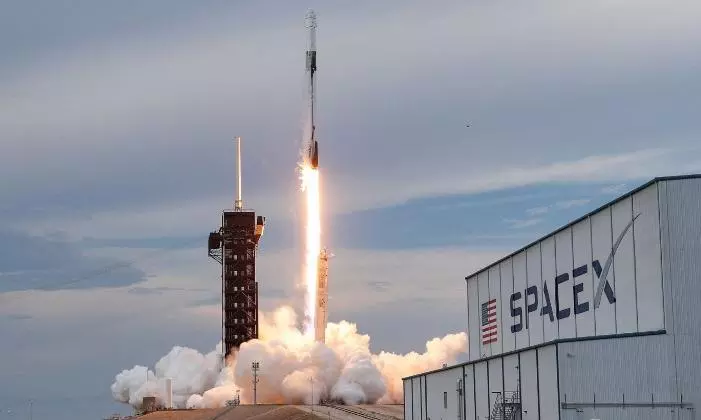

New Delhi: SpaceX's Falcon9 climbed skies on Tuesday carrying Indian Space Research Organisation's (ISRO) GSAT-20 communication satellite marking the first commercial collaboration between Isro and Elon Musk’s company, according to India Today.
The communication satellite, named GSAT-N2, weighing around 4,700 kg, features a Ka-band high-throughput communications payload having a mission lifespan of 14 years, which is aimed at enhancing India's communication infrastructure.
When it goes operational, the satellite will expand services across the country ensuring internet connectivity in remote areas alongside in-flight internet services.
The satellite GSAT-N2 comes with 32 user beams including eight narrow spot beams and 24 wide spot beams to be supported by hub stations across the country.
New Space India Limited (NSIL), the commercial segment of Isro, announced the collaboration with Space X on January 3 earlier this year.
India turned to Space X as the satellite became too heavy for domestic launch vehicles despite having launched over 430 foreign satellites.
The collaboration with Space X marks a shift from Irso’s reliance on European launch services for heavy satellites.
Space X emerged as the viable choice for India after Arianespace currently having no operational rockets alongside as geopolitical tensions further limiting options.
Though India’s launch vehicle the LVM-3 can launch 4000 kg satellite in the Geosynchronous Transfer Orbit, Isro has to look outside for a rocket to launch satellite exceeding that weight.