


India's only mud volcano erupts after two decades in the Andamans
text_fields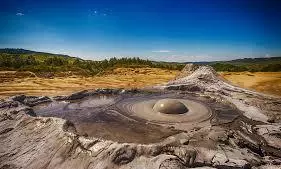

After lying dormant for over 20 years, India’s only mud volcano at Baratang in the Andaman and Nicobar Islands has erupted again, officials confirmed on Friday.
The eruption was reported at Jarwa Creek, Baratang, on October 2.
A senior police officer said, "We received information at around 1.30 pm on Thursday (October 2) about a violent eruption of a mud volcano at Jarwa Creek, Baratang. Such a big eruption was last reported in 2005. The eruption was followed by a deafening sound like an explosion. On receiving the information, local police officers, along with forest officials, visited the spot."
Officials explained that the mud volcano is formed by gases deep underground, created by decaying organic matter. These gases push mud and gas upwards, forming bubbles and craters. "The mud volcano here is formed by gases deep inside the earth from decaying organic matter. It pushes the mud and gas to the surface, which creates bubbles and craters. It is one of the must-visit spots in the Andaman and Nicobar Islands," an official said.
The eruption has created a mound of earth about 3–4 metres high, spreading mud over more than 1,000 square metres. Officials said the eruption is still ongoing, with mud and smoke continuously spewing. For safety reasons, tourist movement to the site has been stopped. The Forest Department has closed approach routes, and the Geological Department has been informed.
Baratang is located nearly 150 km from Port Blair in the North and Middle Andaman district. It is a popular tourist attraction because it is home to India’s only mud volcano. The police have also alerted the Fiber Boat Owners’ Association and local tourist vehicle operators about the suspension of movement towards the site.
Authorities said all safety measures have been put in place for locals and visitors.
This development follows recent volcanic activity at Barren Island, about 140 km from Port Blair. Minor eruptions were reported there on September 13 and September 20.
Barren Island, which lies at the junction of the Indian and Burmese tectonic plates, is uninhabited and covers an area of 8.34 square kilometres. The nearest inhabited areas are Swaraj Dweep (Havelock Island) and the Narcondam Lookout Post, located 140–150 km away. The island has a history of eruptions, beginning in 1787, followed by activity in 1991, 2005, 2017, and most recently in November 2022.
Clarifying the distinction, an official said, "The mud volcano at Baratang and the active volcano in Barren Island are located at separate locations and are not the same. The recent active volcanic eruption on September 13 and 20 was reported at Barren Island, but this one (mud volcano) was reported (on October 2) from a mud volcano in Baratang."